Showing posts with label dinosaurs. Show all posts

Tuesday, 16 June 2015

Ten unusual places to find art

Art in unusual places

1.  An Asian restaurant
Wallpaper by Debbie Plaskett (from near Bury St Edmunds)
Spotted at the (now defunct) Dojo Noodle Bar (Cambridge).


2.  A café.
Mural spotted at the Box Café on Norfolk Street (Cambridge).


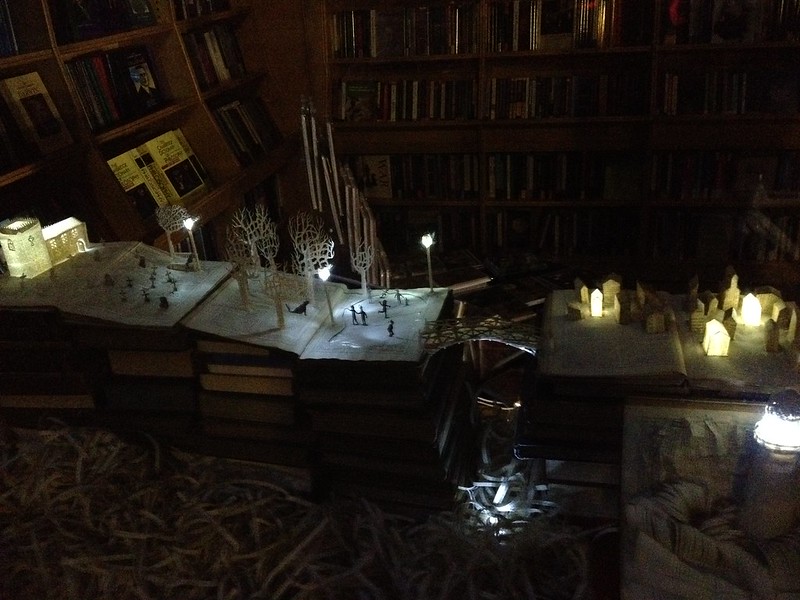
3.  A bookstore shop window.
Justin Rowe's book sculptures, seen every advent time (and beyond) in the Cambridge University Bookshop.  Read my blog post.


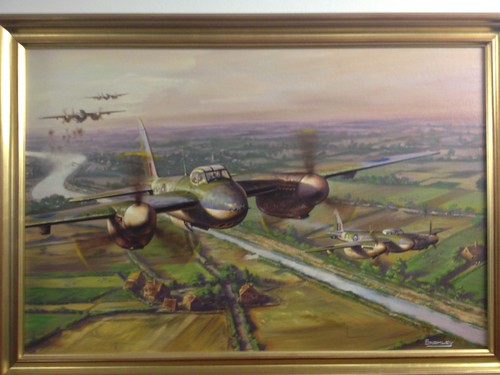
4.  An airforce museum.
Seen at Duxford Air Museum (near Cambridge).  Read my blog post.


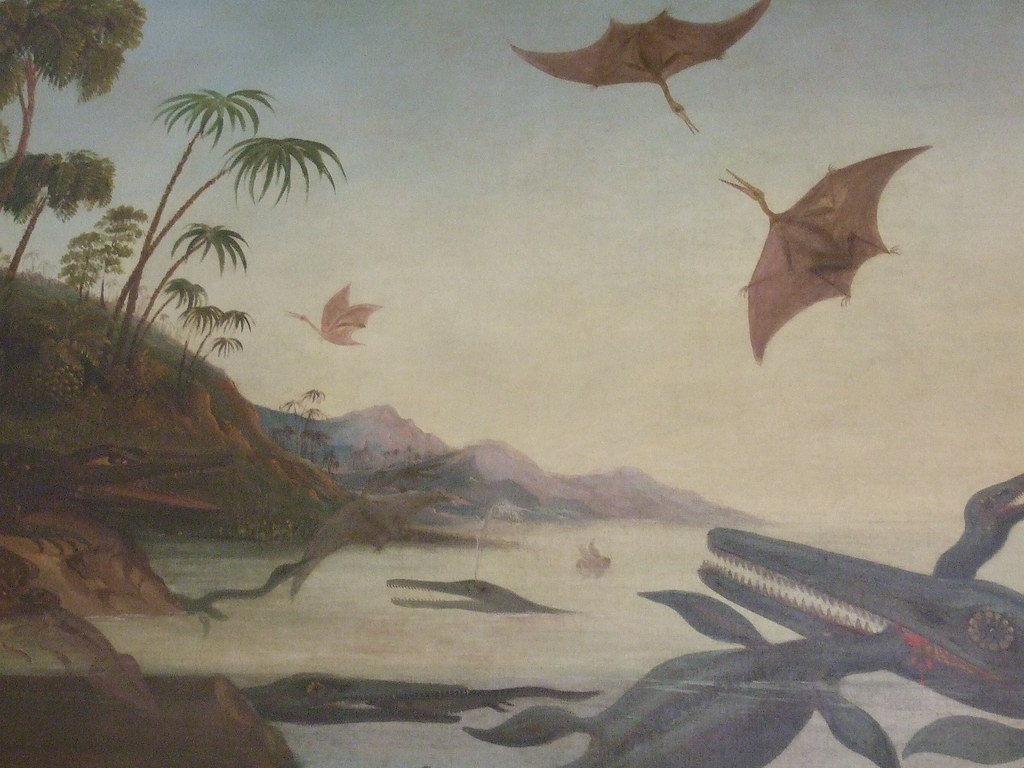
5.  A natural history museum
Discovered at the Sedgwick Museum of Earth Sciences (Cambridge).  Read my blog post.


6.  A hotel
Spotted at the Doubletree by Hilton Hotel, on the river Cam.  Read my blog post.


7.  A swimming pool
The Diver, by Esther Melamed.
Found at Parkside Pool (Cambridge).


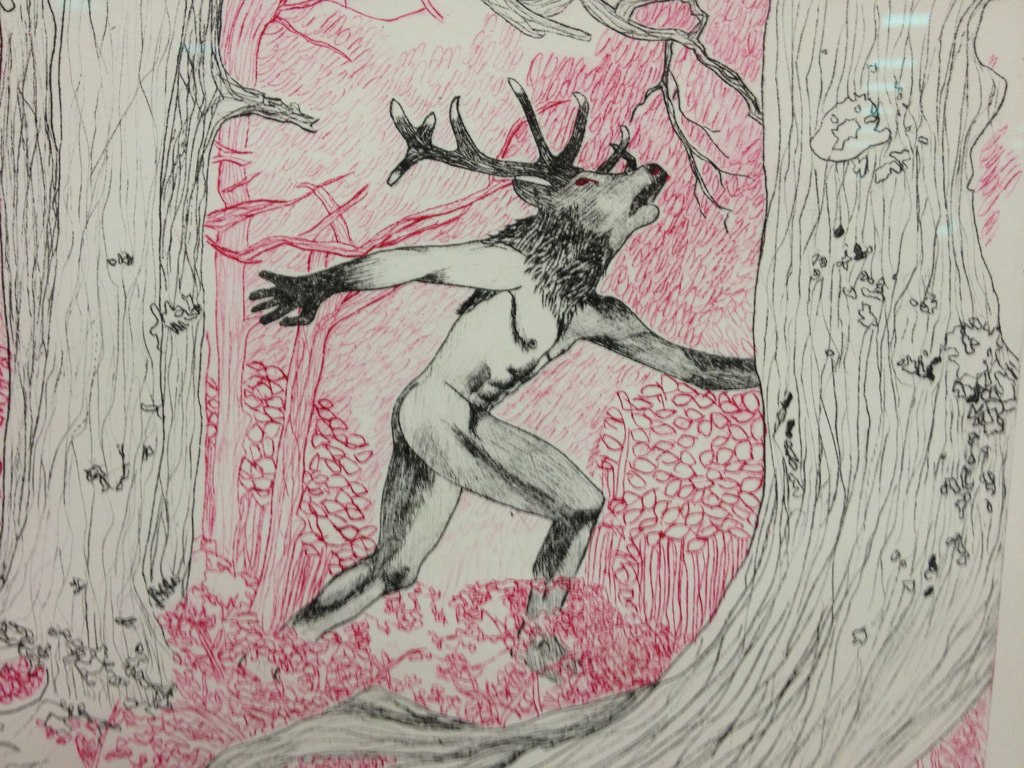
8. An airport
Secret Forest Trails, by Nelda Karklina
Stumbled upon a few years ago at Luton Airport.  Read my blog post.


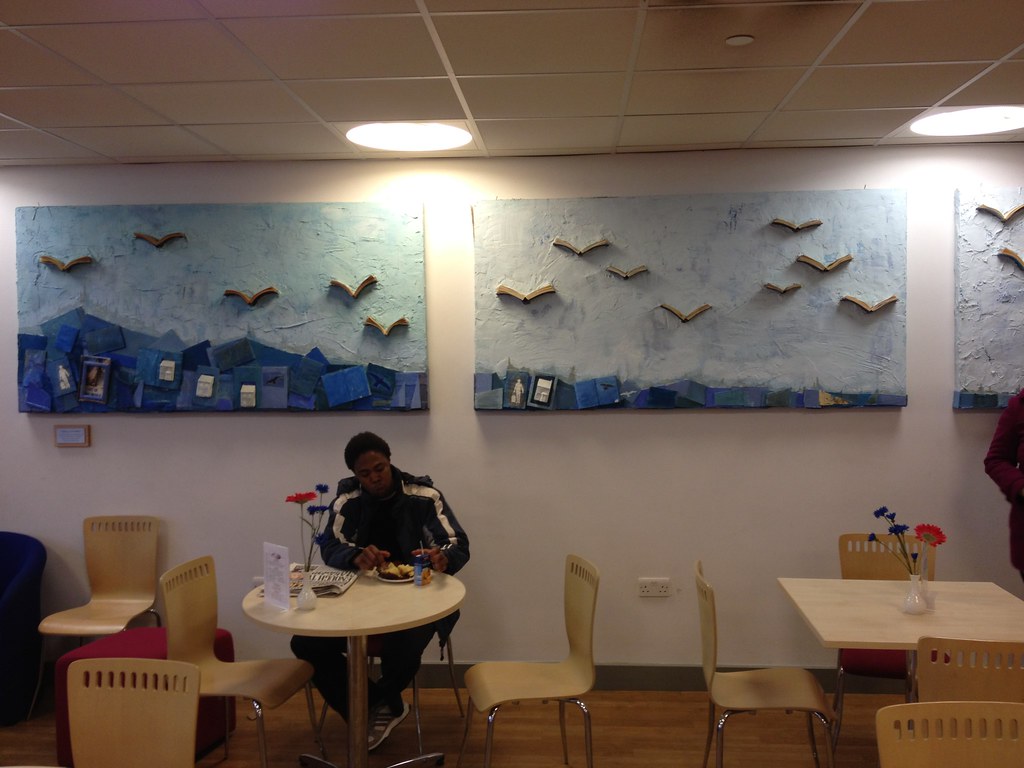
9. A hospital
Jim Anderson's mosaic at Addenbrooke's Hospital (Cambridge). Read my blog post.


10. A round-about
Newmarket Road! (Cambridge)  Read my blog post.


Not so unusual:

Finally, you might think that libraries were unusual places for art.  Books? Yes.  Art?  Not so much.


But I learned, during my blog quest to find art in Arbury, that this is not so.  Libraries are, in fact, excellent places to find art, and it's not at all unusual to happen upon a sculpture or a wall relief in a library.  Still, though, I wanted to append these pictures at the end of my 'unusual places' list.

Some art I've come across in Cambridge libraries:

Book art at the Central Public Library in the Grand Arcade.  Read my blog post.


From Audubon's book of birds.  Seen at the Cambridge University Library and blogged about here.


Owl sculpture in Arbury Public Library.  Read about it here.
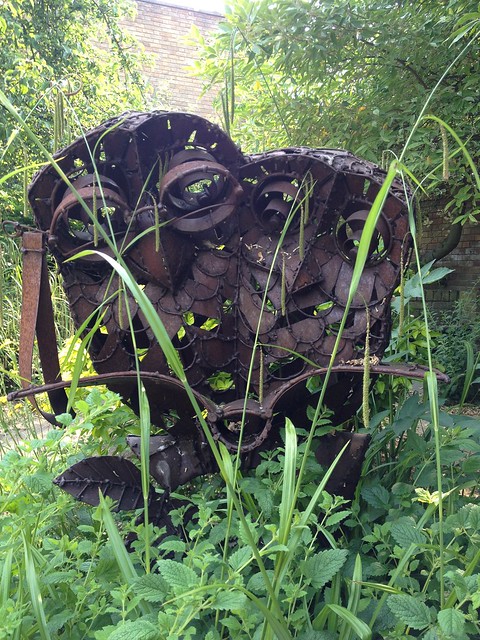


Varallo, by Samuel Butler.  Seen at an exhibition at St John's College Library in 2013.


Have you come across some art in an unusual place?

And if so, where??  Let me know in comments.

Monday, 18 March 2013

Behind-the-Scenes at a Science Museum: Behind every great dinosaur, there's a great artist

Compsognathus 1

On Saturday, I went to the Sedgwick Museum of Earth Sciences, as part of an outing to the annual Cambridge Science Festival.

But (pssst) I was not interested in the science.  I was on the hunt for art.

Because here's what I discovered:

Nobody's imagination is fired by bones neatly arranged by palaeontologists.

bones


Nobody's imagination but the palaeontologists' themselves, of course!

laura dern and sam neill in jurassic park
Dr Sattler and Dr Grant (Jurassic Park)

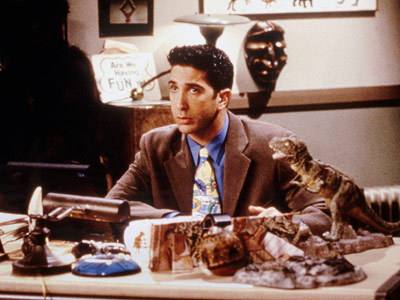
 Dr Ross Geller (Friends)


The rest of us, it seems, need blood and guts, T-rexes tearing herbivores limb from limb, Jurassic reptiles anachronistically attacking humans, and general monster mayhem.

We want our fossil digs to be transformed into exciting figurative stories.

© Errol Swanepoel, photo of West Coast Fossil Park dig

Enter Bob Nicholls.  

Bob Nicholls is a "palaeoartist" who paints pictures and murals, makes 3-D models and works with multi-media.  You can hear him talk about his life as a dinosaur fanatic at the Sedgwick Museum on Thursday, 21 March!  I have a ticket and look forward to an evening of tooth, tusk and claw.

Robert Nicholls, T-rex


And enter Richard Hammond.

This model of a Compsognathus longipes was made by Richard Hammond.  Richard Hammond is now a 'senior character artist' for computer games at Lionhead Studios in Guildford.  But in the 1990s, he was a natural history model maker.  (I had not even realised that either of these artistic careers existed...!)

The museum label explains:
"We do not know if Compsognathus had down, bristles or feathers, but the patch of elongate scales over the shoulders (greenish in the model) have been placed there to highlight this possibility."
The grammar is ambiguous but I'm assuming the 'possibility' refers to feathers.  Hello, raptor bird.

Compsognathus longipes, by Richard Hammond

Compsognathus 2


An 1820s vision of 'Ancient Dorsetshire'

Then there is the fantastical painting by local artist Robert B. Farren, based on the even more fantastical sketch by the geologist Henry De la Beche.  I have loved this painting for years.


Sedgwick Museum


Henry Thomas De la Beche, Life in the Jurassic Sea


jurassic 03

jurassic 02


Portrait of the geologist as an elderly man


The same painter, Robert B. Farren, also produced this portrait of Adam Sedgwick, pioneer geologist, for whom the museum is named.   It hangs above cabinets full of little stones and shells.  Sedgwick wears the robe of a scholar of Trinity College.  I like the way his hand spans the entire Earth.


Robert B. Farren, Adam Sedgwick

3-D Sedgwick


Here is Adam Sedgwick again, as a life-size sculpture, looking benevolently down at us from his niche.  He holds a hammer and a fossil.  I wish I knew who the sculptor was.

Adam Sedgwick


Adam Sedgwick face

Adam Sedgwick fossil

And Darwin, too

A bust of Charles Darwin hovers high up on a wall.  The sculptor is Anthony Smith who also made the Darwin sculpture in Christ's College.

Anthony Smith, Charles Darwin bust 2009
Anthony Smith, Bust of Charles Darwin, 2009 (commissioned for the Darwin bicentenary)

Darwin bust in loco


Vitrines are beautiful, too


Earlier I said that our imaginations are not fired by bones and stones.  But this is not entirely true.  The old Victorian glass cases with their hand-lettered labels and geometric patterns have their own aesthetic charm.

Inferior Oolite (Sedgwick Museum)

shells Sedgwick Museum


Jannis Kounellis knows this:

Jannis Kounellis, from his 2002 exhibition at the Contemporary Art Museum Ghent


More on Cambridge dinosaurs:  Dinosaurs by the Chapman brothers

Permalink:  http://artincambridge.blogspot.com/2013/03/behind-scenes-at-science-museum-behind.html

Thursday, 13 September 2012

Chapman dinosaurs in Jesus College


Walking among dinosaurs in Jesus College

I came across the dinosaur group in Jesus College on a sunny autumn day.  There are three of them:  an iconic Tyrannosaurus Rex, a grinning stegosaurus and a third one that I couldn't identify. 


They stand directly on the lawn of what is Library Court.  They are sculptures but they are not on a pedestal.  And they are a group.  This has a decided impact on how we look at them.  In fact, I didn't so much look at them as move among them.  My impression of the group changed as I walked back and forth and round about.  And the sculptures do not only interact with the visitor and with each other but also with their environment.  See how their shapes echo and play with the shapes of nearby nature and architecture?


I'm not sure what counts as life-size for dinosaurs but these beasts are certainly larger than human-size.  You can see them from afar but you can also approach them close up.  One of the joys of open-air sculpture is that you can touch and crouch and look up at it from odd angles.  And as with every sculpture, the best part comes from walking around it and seeing how it changes with the shifting perspective.


Experience them with more senses than sight.  Touch them: their flanks are rough and smooth at the same time; warm in the sun, cold in the shade.  Knock on their sides and listen to the sound.  You can even smell them (would be interesting to try on a rainy day).

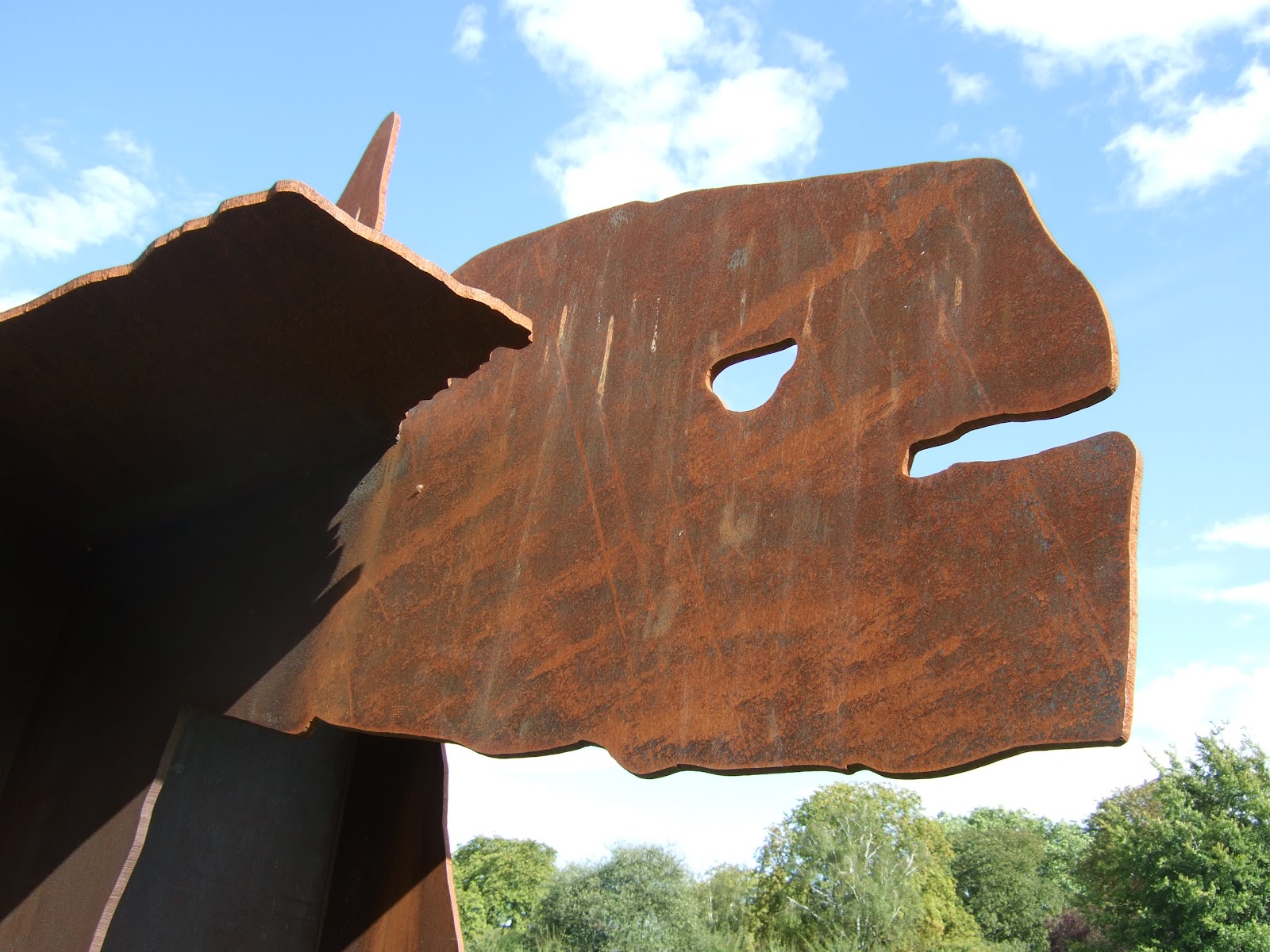
They are made of cor-ten steel, a kind of steel that forms a rusty coat.  Up close, the material reminds me of construction sites and steampunk factories.  They are like industrial ruins and so evoke thoughts of time passing and extinction.


A plastic label proclaims the dinosaurs to be by Britart brats Jake and Dinos Chapman which came as a surprise to me!  But I was not reminded of the Chapman brothers' perverse and cruel installations.  Instead, I thought of  palaeontology museums, dinosaur attractions, and of Richard Serra's huge rusty steel sculptures. 

What do these dinosaurs make you think of?


What and were:
Jake and Dinos Chapman, The Meek Shall Inherit the Earth (But Not the Mineral Rights), 2007, cor-ten steel 
Where: Library Court, Jesus College, Jesus Lane, Cambridge, UK

Update 2014:  Please note that the Chapman dinosaurs are no longer in Cambridge!  It was only ever a temporary affair.  So great while it lasted...!

More Cambridge dinosaurs here:
Dinosaur art at the Sedgwick Museum
Related Posts Plugin for WordPress, Blogger...