Showing posts with label links. Show all posts

Friday, 21 March 2014

John Craxton exhibition reviews: Blogs and the media

Source: Your Paintings BBC.  © estate of John Craxton 2013. All rights reserved, DACS photo credit: Bristol Museum and Art Gallery 


The John Craxton exhibition at the Fitzwilliam Museum (I recommended it here) has generated quite a few reviews! 

Here's my selection:

Reviews in personal blogs

Juliet Miller says:
"Craxton is an interesting painter who has not been very widely known."

One of her favourites:  Four Figures in a Mountain Landscape

"It evokes Greek mythology but is painted with a very English hand. [...] I wanted to be in this rough, rocky landscape myself or even live the life depicted."

Conclusion:

"If you are interested in British painters of the pre- and post war period this view into the internal world of a private yet exuberant painter is certainly worth the trip."


Joseph Scissorhands


Joseph Scissorhands says:

"I had seen two of his paintings at Tate Britain fairly recently and was curious to see more."

One of his favourites:  Four Figures in a Landscape

"which shows his [Craxton's] mastery of composition, line and tone."

Conclusion:

"I enjoyed this show as it was a bright blast of Mediterranean sunshine on a wintry Cambridge morning."


Chris Priestley


Chris Priestley says:

"I like the exhibitions at the Fitzwilliam.  They tend to be small and a little bit eclectic."

One of his favourites:  
"my favourite being a small picture - a tempera I think - of a goat."

Conclusion:
"I don't know what I make of John Craxton's work.  [...]  Some of his work I really like, but there is a lot I really don't like.  His influences are possibly too readable."


Source:  Your Paintings BBC. © estate of John Craxton 2013. All rights reserved, DACS
photo credit: Tate

Reviews in the national pres


Richard Dorment says:
 "John Craxton, who died in 2009, was the last Romantic. Or rather neo-Romantic."


One of his favourites:
Doesn't cite a favourite picture.  Still Life with Cat and Child does "amount to pastiche.


Conclusion:
"He wasn’t an artist of the first rank but he was inimitable. This show is just the right scale and it comes with a beautifully illustrated book  ... by his friend Ian Collins."


Andrew Lambirth says:
"[Craxton's] finest paintings lead the viewer into a visionary universe of colour and light and bounding structures, whose taut rhythms release a feeling of euphoria in the beholder and beguile the imagination with intimations of visual splendour."


One of  his favourites:  Landscape, Malevizi, Crete
"...the finest example I’ve seen in recent years is ‘Landscape, Malevizi, Crete’ (1952), a superb balance of pattern and description. A painting of that quality and joyous, seemingly effortless execution, a perfect blending of linearity and colour, is missing from the Fitzwilliam."


Conclusion:
"Craxton is actually quite a lot better than the sum of the Fitzwilliam show, which offers only a very partial view of this complex artist."


Michael Prodger says:
" 'A World of Private Mystery: John Craxton RA (1922-2009)', a small but choice exhibition at the Fitzwilliam, is an overview and reminder of the career of this unfashionably joyous painter."


One of his favourites:  
"One of his most unaffectedly pleasurable paintings is a colour-saturated image of three sailors eating a meal of prawns, squid, sardines and salad that is mouth-watering in every sense." 

 
Conclusion:
"A man of great charm, Craxton became friends with Patrick Leigh Fermor in Greece and it is through his drawings for the scholar-traveller’s dust jackets that he is now best known." 
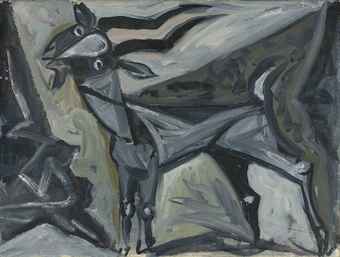

Source:  Christie's.  John Craxton, Grey Goat.


Reviews in blogs and the national press: a comparison

• Blogs are less wordy.  Sentences are shorter.  Blog authors adapt their prose to the way reader quickly scan the screen.


• Blogs are more personal.  Blog authors state personal preferences.  They tell stories about how and why they visited the exhibition.  One author said their friend had wanted to see it; another commented on the weather.


•  Reviews for the national press  are longer.  They include quotations (from the artist or the artist's friends).  They name influences.  They offer stylistic categories ('neo-Romantic', 'Arcadian').


•  Reviewers for the national press  sometimes assert their own credentials and authority.  The reviewer for The Spectator, for example, explained that he had himself curated two exhibitions.  Perhaps they feel the need to do this because they are getting paid?


•  Reviews for the national press can be a bit pretentious and formalist.  Phrases like taut rhythms or colour-saturated don't tend to appear in blog reviews.


•  Reviewers for the national press make more of the artist's reputation and the question of artistic quality:  not an artist of the first rank or unfashionably joyous or quite a lot better than the sum of the Fitzwilliam show.


What type of review do you prefer?  Click on the little pencil below (where it says 'no comment' or 'comments') and leave a comment. 

Also: judge for yourself and visit the exhibition.  John Craxton, Fitzwilliam, ends 21 April.

Tuesday, 12 March 2013

The top four free phone apps for art in Cambridge

Do you have a smart phone and want to keep up with art on the go?  Here are my four favourite mobile apps for keeping up-to-date with the art world of Cambridge.  


1.  Live Cambridge


Great little app for quickly checking what's on and its own 'Art' category.  Also lists films, comedy, theatre, music, local events  and 'Style Week'.  The 'Walk 2012' lists 6 different routes with landmarks , incl. some art venues.  Other features include a short restaurant guide, train times (although not 100% reliable) and a Guide to colleges, museums, gardens and (this is handy) toilets.


Limitations:  The listing is by no means comprehensive, and the 'Art' section is skewed towards University of Cambridge events.

Verdict:  It's a fun and handy quick-reference tool.  Plus the interface is nice and colourful.

Best discovery:  This is to do with the art of Indian filmmaking...  :-)  A few weeks ago, this app told me that the film Jab Tak Hai Jaan (directed by Yash Chopra) was being shown at Cineworld, and I rushed out to see it.  Wouldn't have known about it otherwise!


2.  Cambridge


Hundreds of events hosted by the colleges and institutions of the University of Cambridge.  The best thing is that you can sort the 'Events' by 'Categories'.  One category is 'Exhibitions', and another is 'Talks'.  'Talks' includes lunchtime lectures at the Fitzwilliam and events at Kettle's Yard.


Limitations:  Clearly it lists only University of Cambridge events.  And it's patchy:  none of the art history and classics research seminars is listed, for example.  Boring interface.

Verdict:  On the plus side, you get an overview of tons of public events and exhibitions.  No time to see them all!

Best discovery:  Lunchtime talk on 13 March at 12.45 in the Fitzwilliam Museum on the ancient Greek Lansdowne Relief by James Whitley, Professor in Mediterranean Archaeology at Cardiff.  Found out about this via this app.  (The link takes you to the 'University of Cambridge What's On' blog.)


3.  Art Guide


This lists selected shows from all over the UK.  It includes a nifty 'Nearby' map with museums and galleries marked in, and a 'Trip Planner' for visits farther afield.  Includes images of the exhibited artwork, an overview per exhibition, exhibition highlights, and 'What the Critics Say'.  Plus contact details and 'How to get there'.  Can be sorted by 'Must See', 'Popular' or 'A-Z', and alerts you to the 'Last Chance' to see exhibitions that are about to end.  You can also make your own 'Wishlist' by adding a star to your favourites.

Join the Art Fund for discounts to exhibitions nation-wide.


Limitations:  Highly selective:  doesn't include everything!

Verdict:  But sometimes you don't want info to include everything; you'd like someone to pick and choose for you.  The selection is good, and it's great to have actual pictures of art.

Best discovery:  I found out about the Jeff Koons exhibition at the Royal Pavilion in Brighton, from May - September.  For me, this is incredibly exciting, and I had no idea it was on before I got this app! (The link takes you to the Art Fund website.)


4.  Cambridge Sculpture Trails


Brilliant app that summarises info about the three fabulous Cambridge Sculpture Trails.  You get a map, divided up into the three Trail regions:  city centre, north and west, and south.  Each sculpture is pictured, with artist, title and date, and a short paragraph with interesting context and information.  Plot your path through town, using the map; hunt for statues; then read about them on your phone.


Limitations:  No search function.  This applies to the Cambridge Sculpture Trails website as well.

Verdict:  The top art app for rambling about Cambridge in search of sculpture.

Best discovery:  Matthew Lane Sanderson's Grasshopper.  Watch this space:  I will blog about this soon!

Find out more:  Article on the Sculpture Trails app in the Cambridge News.


These apps are free so so you can try them out at leisure on your phone, ipad or other mobile device.  Let me know how you get on with them via email!  And if you know of any others that I've not listed here:  do tell me about them!

If you have no mobile device:  just scroll on by and sorry for being irrelevant...  :-)

Further reading:  Hasan Niyazi's excellent review of the Raphael at the Louvre app


Please note that I am not affiliated to any of these apps.


Permalink:  http://artincambridge.blogspot.com/2013/03/the-top-four-free-phone-apps-for-art-in.html

Sunday, 10 February 2013

Sneak preview: Arty events at the Cambridge Science Festival

University of Cambridge Science Festival, 11 - 26 March 2013

Source:  Festival brochure cover by Tim Parker.

Plan ahead and pre-book!  Choose from hundreds of events at the Cambridge Science Festival whose guest director this year is Benedict Cumberbatch.  I have picked out for you the best of the art-related science events.  So have fun choosing how arty you want your science to be this March!


Visual arts

Map it
Kettle's Yard. Free drop-in.  12-24 March 2013 (but closed on Mondays), 11.30-5 pm. 
Wales-based artist Anne-Mie Melis will a family-friendly photomontage to encourage you to find your own connections between art and science.

Caught on camera:  engineering in action
Michaelhouse CafĂ©, Trinity St.  Free exhibition.  11-23 March (closed on 17th).  8 am - 5 pm.
Entries from the photography competition at the Department of Engineering.


Science and the Renaissance printing press: a fruitful encounter
Cambridge University Library, Morison Room. Free talk. Wed, 13 March, 5-6 pm. Pre-book here.
View some of the earliest scientific incunabula from the library's collections.  Medical, astronomical, astrological and mathematical books were illuminated by hand and decorated with woodcut illustrations.

While you're in the Morison Room, use the opportunity to look at the stonecarved letterwork by the Kindersley workshop, displayed on the walls.

The American woodsman: John James Audubon and The Birds of America
Cambridge University Library, Morison Room.  Free talk. Mon, 18 March, 5-6 pm.Pre-book here.
Learn about and view The Birds of America by the French-born naturalist John James Audubon, one of the most lavish plate books ever produced (first published 1827-39).


White Gyrfalcons, by J.J. Audubon.  Source: Wikipedia.


A goodly spring of flowers: early botanical books in Cambridge University Library
Cambridge University Library, Morison Room.  Free talk. Wed, 20 March, 5-6 pm. Pre-book here.
Learn about early botanical books, from 15th-century herbals illustrated with woodcuts to elaborate 18th-century plate books.


Biological design:  the history and future of plant architecture
Sainsbury Laboratory Auditorium, 47 Bateman St.  Free talk. Wed, 13 March, 7.30-8.30 pm.Pre-book here.
A talk about the history of plant architecture but the main arty reason to go is that you'll get the chance to peek into the award-winning Sainsbury Lab (normally closed to the public).  Find out what's great about the Sainsbury Lab in my blog post here.


The science behind conservation:  caring for museum collections
Fitzwilliam Museum.  Free talk and tour. Fri, 15 March, 2-4 pm.Pre-book here.
Peek behind the scenes of the Fitz and find out about conserving artefacts, saving them from the effects of daily life, from sunlight to pests.


Imagination: the door to identity
Anatomy Lecture Theatre, Downing Site, Downing Street. Free talk.  Sat, 16 March, 11 am-12 pm.
Behavioural psychologist Nicky Clayton and artist Clive Wilkins explore the nature of imagination.  Read details on a previous version of this talk.

Source:  Festival brochure cover.  Detail.


St John's College and the physical sciences
St John's College, St John's St, Old Library.  Free exhibition. Sat, 16 March, 11 am - 4.30 pm.Pre-book here.
An exhibition of college members to science but the main arty reason for visiting is the chance to wander around the Old Library (opened in 1628), admire its Jacobean Gothic architecture and its Victorian stained-glass windows.


My life as a dinosaur fanatic
Sedgwick Museum of Earth Sciences, Downing St.  Free talk. Thurs, 21 March, 6.30-7.30 pm. Private view of artwork from 6 pm. Pre-book here.
The internationally renowned palaeoartist Bob Nicholls talks about his life as a professional dinosaur artist and fanatic.  


Leviathan (Jurassic), © Bob Nicholls.  Source:  http://www.paleocreations.com/imagePage.php?id=6


Malaria: perspectives from art, science and  history
St John's College, St John's St, Castlereagh Room.  Free talk. Fri, 22 March, 7.30-8.30 pm. Pre-book here.
Artist Deborah Robinson explores the world of malaria research at the Wellcome Trust Sanger Institute.  Speakers from the arts, genetics research and medical history discuss their experiences of malaria.


Poetry in the museum

Step inside
Museum of Archaeology and Anthropology (MAA), Downing St.  Free poetry performance. Tues, 19 March, 7.30-8.30 pm. Pre-book here.
Poets-in-residence Daljit Nagra (MAA), Ann Gray (Botanic Garden) and Jo Shapcott (Polar Museum) present highlights of their work, inspired by Cambridge museums and collections.
Click on their names to read a poem by each.


Films beyond the movie theatre

Travelling Salesman
Centre for Mathematical Sciences, Wilberforce Rd. Screening. £5.50. Thurs, 14 March, 6.30-8.15 pm. Pre-book here.
See the award-winning indie film Travelling Salesman about four brilliant mathematicians.

Arctic film week: voices from the north
Cambridge Arts Picturehouse (in partnership with the Cambridge Film Trust and the Polar Museum). Screenings. 17-24 March. Pre-book here.
A series of films by and about the Arctic Inuit of Canada.


The illustrations for the Festival brochure and website are by Tim Parker who graduated from the Cambridge School of Art last year.  Click here to visit Tim's tumblr blog.

Read the entire programme of events at the Science Festival website.
All the info above is from the Science Festival brochure (also available at the website).

Have a lovely arty (and 'sciencey') Sunday!


Source: Festival brochure.  Illustration: Tim Parker. 


Related Posts Plugin for WordPress, Blogger...