Showing posts with label flowers. Show all posts

Wednesday, 6 April 2016

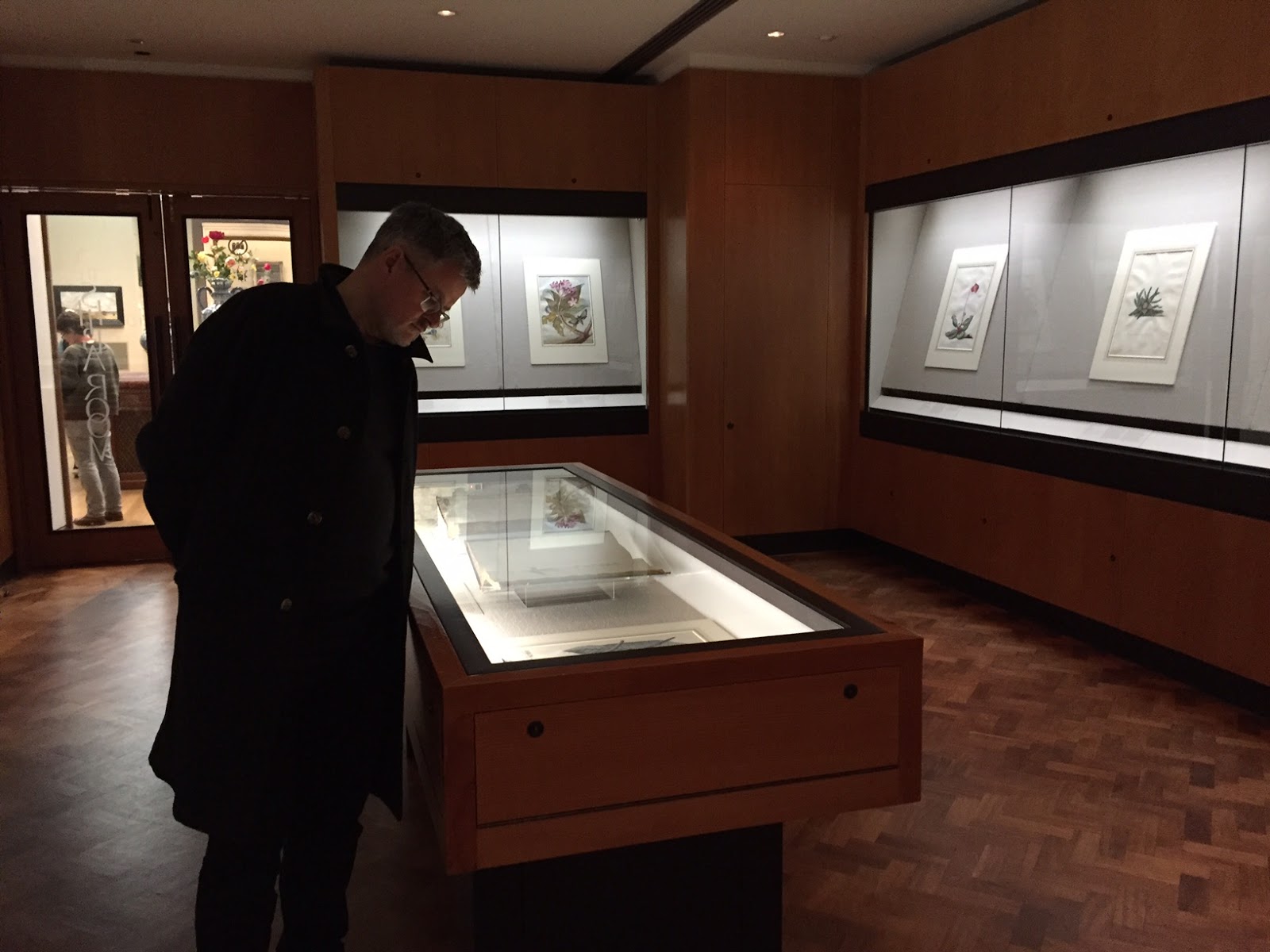
Crawling with Life: An exhibition of flora and fauna at the Fitzwilliam Museum


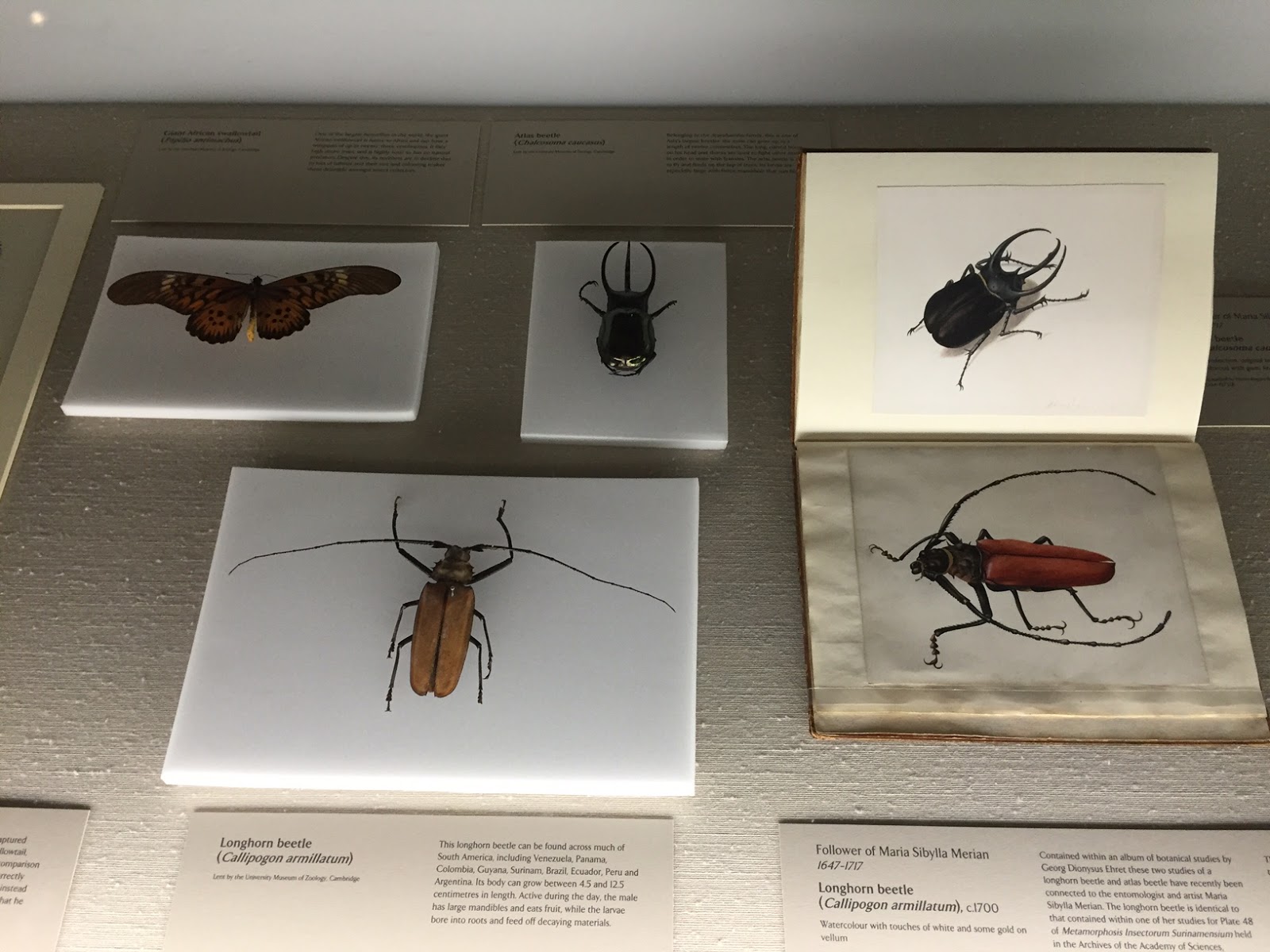
The first thing you see when you enter the small exhibition of 17th and 18th-century flower drawings, is a giant black beetle with three impressive-looking horns.

 The beetle sits in a typical old-fashioned flora and fauna display case; it's pinned to a board in the classic way of a scientific specimen.

In fact, this beetle, alongside another beetle and a butterfly, have been borrowed from the Zoology Museum in Cambridge and placed next to watercolour images of themselves.  It is as if we have the portrait and the sitter all in the same glass vitrine.

Atlas beetle (Zoology Museum, Cambridge) and Follower of Merian, Atlas Beetle, c.1700, watercolour with some white and gold
The watercolours are by an anonymous artist from around 1700; they are beautifully detailed and strangely evocative.  The atlas beetle casts a shadow onto its pristine white background.  Is it crawling across a sheet of paper?  Its legs are exquisitely fragile.  The beetle appears to be moving diagonally upwards, from left to right.  Although it's 2-D paint, it seems more alive than the dead husk next to it.

Add caption
The curatorial decision to include some real biological specimens is genius.  Seeing them transports you back into the world of early modern science, the world before photography and X-rays, the world when artists were scientists and where the only pictures we had of flowers and insects were the pictures painted, etched and drawn by people.

Is it art?  Is it science?  These distinctions blur in your mind as you peer at the displays.


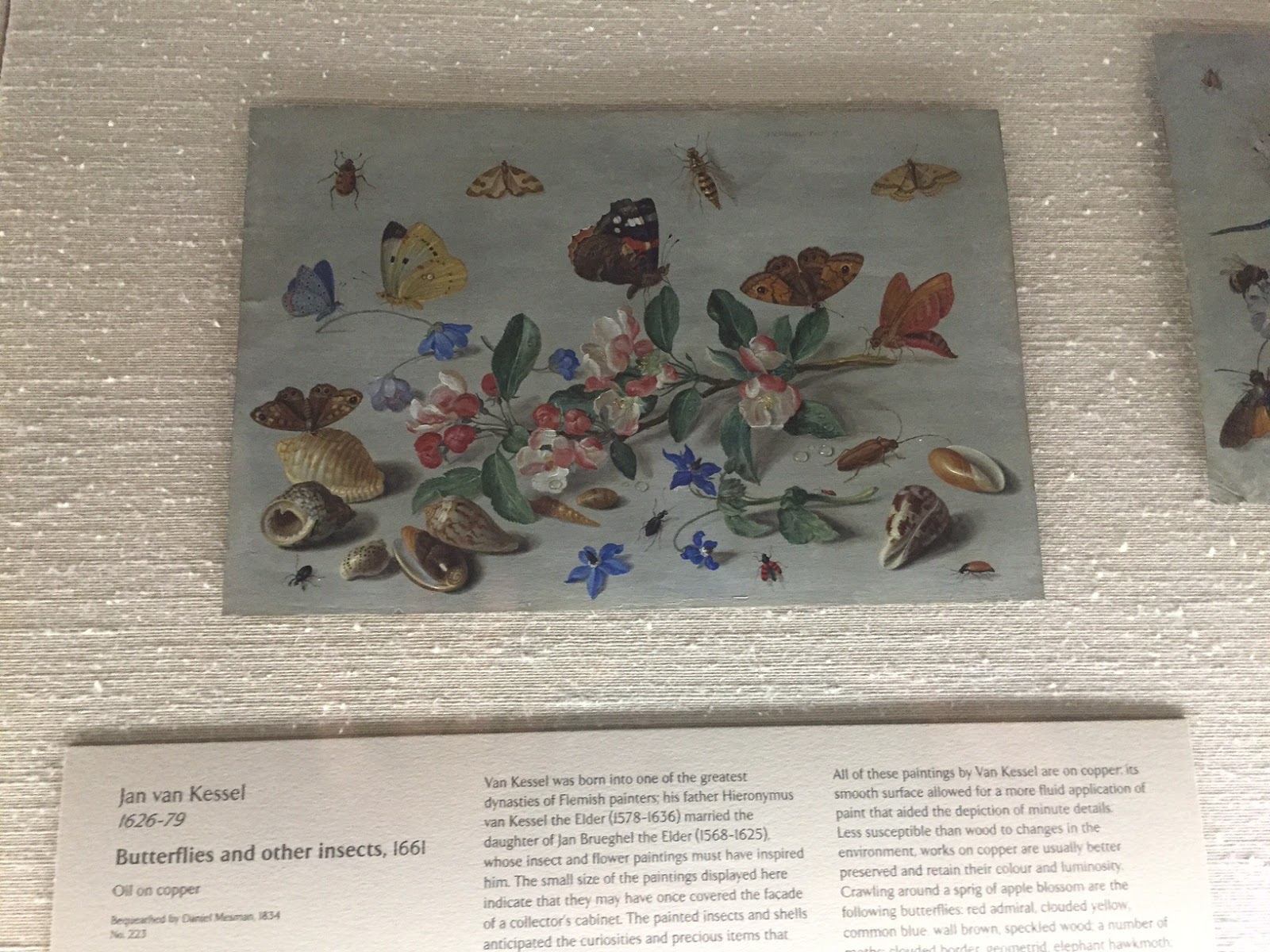
Jan van Kessel, detail from Butterflies and Other Insects, 1661, oil on copper

This Flemish artist, Jan van Kessel, got so carried away by the ecstasy of meticulous naturalism that he included transparent drops of water alongside his blossoms, shells and creepy crawlies.  Look at the drops practically quivering on the leaves and on the pale blue-grey ground.

Add caption

Another nice thing about the exhibition is the presence of two women painters.  In the world of botanical and zoological art, women were leading.  Indeed, practically the inventor of the entire genre was the Frankfurt-born Maria Sibylla Merian whose strangely hypnotic renderings of creatures and plants became the benchmark for all who followed.

Look at her weird depiction of snails and a beetle cavorting under a fleshy plant, all in front of the ubiquitous white background.  Merian did a cut-away to show a snail laying eggs.  Centuries later, nature photographers and David Attenborough's camera team are still vying to capture similar intimacies.


Maria Sibylla Merian, detail from Hyporicum baxiforum, with several snails and a beetle, 1695, watercolour

 The white background is not entirely ubiquitous, though.  Here is another woman, Margaretha Barbara Dietzsch, who, along with her brother, liked to use a black ground. 


Margaretha Barbara Dietzsch, detail from Common Dandelion with a Garden Tiger Moth, watercolour, bodycolour and gum Arabic, 18th C.

A strange nocturnal world unfolds.  It's almost a still life, almost a flower painting (like those in Gallery 17; see my blog post), but without the allegory, without the wilting leaves and the mementi mori.  Yes, a quarter of the dandelion clock is blown away but the caterpillar climbs determinedly on.  And everything is ripe with growth and bursting with life.  These are not melancholy pictures.  This is part science, part art, and 100% rhopography:  the depiction of the trivial, the love of the humble.


Visit the exhibition Crawling with Life: Flower Drawings from the Henry Rogers Broughton Bequest.

Fitzwilliam Museum, Cambridge, Gallery 14.
Ends Sun, 8 May 2016.

It is totally worth seeing!  It's small, too, so you won't exhaust yourself. And free!

Related blog posts:


Permalink: http://artincambridge.blogspot.com/2016/03/crawling-with-life-at-fitzwilliam-museum.html

Thursday, 7 March 2013

Another boring still life

This is part 3 and the final installment of my mini-series on How to look at boring art -- and why.

Last time, I looked at
Mélanie de Comoléra's Vase of Mixed Flowers.

Today it's the turn of:


Jan van Os, Vase of Mixed Flowers.


Jan van Os (1744-1808, Dutch), Vase of Mixed Flowers.  Image source © Fitzwilliam Museum.


I gave myself 5 minutes with this painting -- but ended up doing 8!


Title

The full title on the museum label is: Vase of mixed flowers, including poppies, Crown Imperial, tulips, roses, auricula and gentian on a stone ledge with a bird's nest, grapes, melon and peaches, with a garden behind.

I'm starting to think that these descriptive list-like titles say something about these flower still lifes. There is no hierarchy in this title, just as there is no hierarchy among the objects depicted. Poppies, peaches, roses, eggs -- all are treated with the same careful detail.


What a difference to the kind of hierarchy found, for example, in a portrait or in a religious altarpiece!


A Young Draughtsman, by an unknown painter, 1767 , ©Fitzwilliam Museum

This young man is clearly more important than the sketchy landscape behind him or the plants under his feet (nobody can identify these species...) There is a definite hierarchy: the human figure is more important than sky, rock or grass.


Not so in the flower still life.


Format

The format is vertical; that is, the painting is taller than it is wide. This is a 'portrait' format, suited to humans standing upright, and we associate the vertical format with the 'human'.

(We tend to associate the horizontal format with landscapes. And reclining nudes.)


So the flowers are treated here a bit like a portrait.


Comparison

The format is the same as that used for Mélanie de Comoléra's still life.


The composition is also similar: we have the light falling from left, the ledge ending at left, the items not cropped by the edge, the same profusion of flowers.


Of dead flowers. We're not in a living garden. These flowers have been cut from their roots and will soon die.


In addition to the flowers, we also have some fruit.


But we also have some humorous signs of animal life!


Fauna

See the black mouse in the foreground? It nibbles on a piece of fruit (or a nut?).

And see the nest with its four eggs among spiky stalks of straw.


Notice also the butterfly.


sketch van Os
My sketch of the Van Os

Texture

Look at the velvety peachy texture, the glistening grapes, each with a white highlight. They are ripe to bursting. The cut-open melon shows a sign of human intervention but the melon is now left... to rot?

Jan van OsVase of Mixed Flowers.© Fitzwilliam Museum.


The trivial

Remember how the title echoes the non-hierarchical nature of the still life?

This is not about power, action, emotion, history, prayer or plot. This is about the minuscule, the trivial, the un-important, the proliferation of material things. Perhaps there is some symbolism hidden away somewhere but mostly I find myself baffled by the thing-ness of the objects and struck by the virtuosity of painterly skill.


The art historian Norman Bryson had this brilliant insight (in his book
Looking at the Overlooked:  Four Essays on Still Life Painting (1990):
'still-life is the world minus its narratives, or better, the world minus its capacity for generating narrative interest.'

Gallery 17

Gallery 17 is
full of these kinds of flower still lifes.


Jan van Os's picture is the second from the left, above the bust on the right-hand wall.
All the still lifes here are painted to a similar formula. The same botanic species of flower recur. Everywhere, the vases are barely visible: the flowers stand up, as if by themselves.

There are scores of these pictures. Clearly, flower still lifes were incredibly popular!


The Fitzwilliam website informs us that
Gallery 17 houses the collection of Major The Honourable Henry Rogers Broughton, 2nd Lord or Baron Fairhaven, of Anglesey Abbey near Cambridge, donated to the museum upon Fairhaven's death in 1973.


Permalink:   http://artincambridge.blogspot.com/2013/03/another-boring-still-life.html

Tuesday, 5 March 2013

Why I hate Gallery 17 (in the Fitzwilliam Museum)

Gallery 17, Fitzwilliam Museum, Cambridge; photo © Fitzwilliam Museum

Gallery 17 is the name of the room with flower still lifes in the Fitzwilliam Museum.  

The Fitzwilliam's Gallery 17 website informs us:  

"This gallery contains a stunning collection of flower-paintings by Dutch, Flemish and French artists from the 17th-19th centuries."

But, alas, I don't find these paintings stunning at all...   I tend to dash through this room with eyes fastened firmly on the exits straight ahead.  But even as I rush along, I can't help noticing, in passing, the blurred masses of dullness:  wilting flowers, dead leaves, browned stalks, meticulously detailed chrysanthemum petals, tulip petals, poppy petals, the petals of flowers whose names I don't know and never want to learn.  Endless acres of this tedious stuff, from floor to ceiling, all herded into this one uninspiring room of the Fitz.


Photo © Fitzwilliam Museum


Why stop?  Why not hurry onwards to see Rembrandt, Rubens, Raphael?  Lush nudes, cute babies, gorgeous landscapes, challenging abstract paintings?


Why stare at a still life?

As promised in my last post which was all about how to look at a boring painting -- and why, I went and tasted a dose of my own medicine:  I went to the museum to be bored.  To be bored, but also determined to have at least one interesting thought about my boring painting.

I chose to look at two flower still lifes.  I gave myself ten minutes per painting.

The first one I chose is this Still Life with Boring Flowers -- whoops, sorry, I mean:

Vase of Mixed Flowers, painted by Mélanie de Comoléra,
probably between 1800 and 1850.

Mélanie de Comoléra, Vase of Mixed Flowers, image source:  © Fitzwilliam Museum

It's of course immediately interesting that the picture is painted by a woman.  Try going to your local museum and counting the number of works of art made by women...  Unless your local museum is the National Museum of Women in the Arts in Washington, I will bet that you're going to find precious few women artists.

Works by women are also few and far between at the Fitz so let's be thankful for this one!

Title

The full title of the painting, as listed on the label next to the picture, is Vase of Mixed Flowers, including poppies, auricula, daffodils, hyacinths, asters, carnations and a foxglove on a marble ledge with sprays of auricula and roses, copied after Jan van Dael (1764-1840).

Two things about this title:

1)  A title should not be a list of every single thing we can see.

2)  What a pity that our joy at finding a woman artist is here tempered by the information that, oh, it was only a copy after a man's painting.  Still:  if there was call for a copy, the painting must have been popular!


Flora

The gardeners among you will recognise all these flowers but the only species I can identify are the roses and the poppies.  All else is an airless, stifling profusion of petals, blossoms, leaves, tendrils and stems, crammed together against a dark background.

Some flowers are seen from below or from the back.  Some (like the poppy at the top) unfurl in bud form next to their full blooms.  Many of them are so top-heavey that they seem on the verge of wilting.  Thus, in the midst of bursting life:  the imminence of death.

To me, these fat flowers are sickly in their fertility and slick colourfulness.

We see different shapes and colours:  velvety pink; waxy green; tight buds in clusters; palest pink and white; yellows, reds, blues.

Do these flowers even all bloom at the same time?

Fauna

There is a butterfly at right, tiny and brown next to the pink, blue, white and yellow cacophony in the vase.

And there seems to be another murky butterfly creeping around among the foliage at left.


Space

The flowers are all stuffed into a vase: how can it hold them all?  And the ledge:  where is that positioned in space?

In among the thicket of vegetation, there's a kind of jungle perspective.  

The shape of the bouquet respects the edge of the canvas.  No flower is cropped.  

Whites and yellows are grouped along the centre.  Darker colours sit around the edge.  And pink anchors the composition below.

Frame

The whole picture is surrounded by an ornate gilt wooden frame that echoes the flower motif with its own vegetal ornaments and arabesques.  Reproductions always never include the frames of pictures which is a pity because it makes every picture look like a postcard.

Here's my sketch of the painting with the frame included:

sketch comolera


Who was Mélanie de Comoléra?

Almost nothing is known about this painter.  Her dates are variously given as 1789-1854 or 1800-1860, or as 'active 1816-1854'.  She apparently worked in Sèvres (France) and London.  Her art teacher in Paris (probably in the early 19th century) was the Dutch floral painter, Gerard van Spaendonck,  who also taught other women to paint flower still lifes:  the Marquise de Grollier, Thérèse Baudry de Balzac, Henrietta Knip, Madame Peigne and Madame Vincent (see Germaine Greer, The Obstacle Race:  The Fortune of Women Painters and their Work, 1979, page 244).

Gallery 17.  Mélanie de Comoléra's painting is at left, above the cabinet.

Tune back in for the next installment of how I studied a boring painting.  Coming up next:

Jan van Os, Vase of mixed flowers, including poppies, Crown Imperial, tulips, roses, auricula and gentian on a stone ledge with a bird's nest, grapes, melon and peaches, with a garden behind.
Related Posts Plugin for WordPress, Blogger...