What is the oldest work of art in Cambridge?
Well, the oldest work of art in the Fitzwilliam Museum is displayed downstairs in Gallery 23 (the gallery entitled Ancient Near East).
The wall-mounted case is marked Palaeolithic Art. It contains some fragments of stone and bone. The label reads:
"The engravings on the left and right side of this panel are the earliest examples of art in the Fitzwilliam. They date to around 12,000 BC, and [...] provide some of the earliest known proof of human beings' desire and ability to draw."
1. Worked limestone flake (it's tiny: 5 cm high).
Found in Laugerie Basse, Dordogne (France). Made c. 12,000 BC.
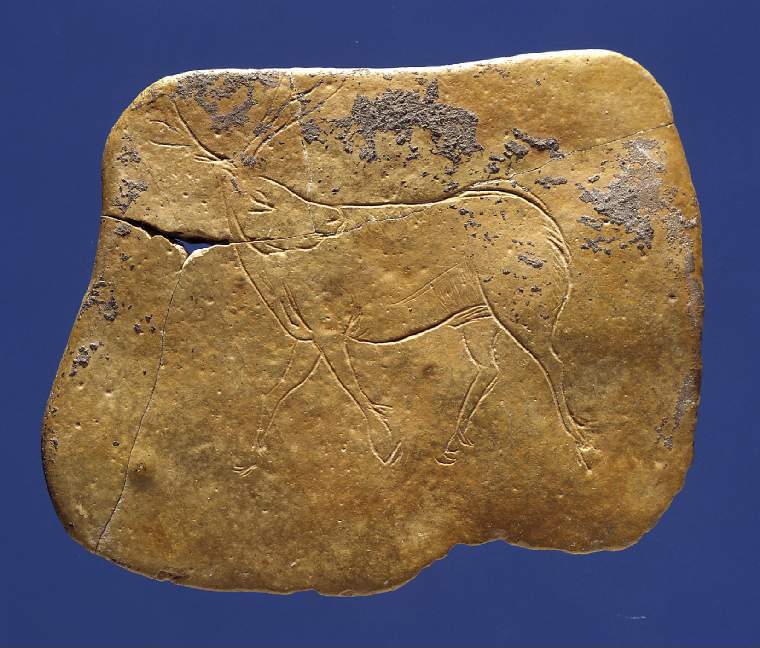 |
| Source: © Fitzwilliam Museum. Reindeer carving. Magdalenian V; Stone Age. |
The label tells us:
"...a very assured drawing: a few strokes capture the legs and shape and movement of this reindeer caught in a very characteristic pose with its head turned back along the flank."
There is also a schist pendant with a bison, ibex and reindeer, and the type of flint burin that was probably used to "create these designs".
More from the label:
Engravings like these may have been thought to possess a magical significance, promoting the successful hunting of the animal depicted.
2. Worked reindeer antler
No Fitz photo available but here's my sketch:

We see a horse's head scratched into a bit of reindeer antler. The label informs us: Upper Palaeolithic, Magdalenian VI, about 11,000 BC. Laugerie Basse, Dordogne.
It's a dark brown-reddish colour with pale, sketch-like incisions.
In the case of the antler, the animal motif may have only [sic] had a decorative function.
Ice Age
The Fitz display makes a welcome change from the hyped-up Ice Age show, currently on at the British Museum (extended to 2 June 2013).
I was very excited about Ice Age (primarily because of this amazing 47-second Hollywood-style blockbuster video, made to advertise the exhibition). But I wasn't as moved as I had expected to be.
The exhibition consisted of many tiny and rather humble objects: scraps of bone, barely-visible scratches on pieces of rock, tiny figurines spot-lit and incongruously juxtaposed with Matisse or Picasso.
The labels were full of hype, some of it contradictory. Here are some examples:
 |
| Ice Age catalogue, with bison |
LABEL: This sculpture of an adult female bison worked for a large piece of mammoth tusk is a masterpiece at least 21,000 years old.
(Me: a masterpiece?)
Realism?
LABEL: It is scaled down in exact proportion from the living animal...
(So: an example of realism, then?)
 |
| Don Valley figurines, © Kirstin Jennings. Source: New Scientist blog Culturelab |
LABEL: Most [figurines] are naked except for some jewellery. In a period of harsh cold weather when clothing was necessity this suggests that nudity was an artistic convention.'
(So: not an example of realism, then? Also, um, nudes are still around in art today, and strangely, clothing is still a necessity although the weather is not quite as harsh and cold. Odd, that, how humans will wear something for reasons other than protection against the elements.)
Or abstraction?
On a female figurine that looks like a stick with breast-like protrusions: LABEL: Such abstraction creates uncertainties that are more intriguing than depictions of reality.
(So were these Ice Age types realists? Or abstract artists? 20,000 years before Picasso?)
 |
| Lions (detail). Source: © British Museum. |
LABEL: The three lions are brilliantly composed...
(Why insist on the 'brilliance'? Can't I judge this for myself?)
LABEL: The changing positions of the legs and tails in each drawing also show a sequence of movement that could be indicative of just one animal running as in animation.
Movies did not start in 1895 (apparently)
Drawings occasionally use techniques that convey movement and the first stages of animation.
(Did our ancestors 20,000 years ago invent motion pictures? Nice idea...)
And performance art did not start in the 1950s / 60s
A male puppet suggests performance art.
(So the notion that performance art was invented in the 1960s as part of the post-modern move against the physical art object is totally outmoded, then...?)
 |
| Performance art as I know it: Yoko Ono, Cut Piece, first performed 1964. Source: Florica's blog. |
Brain art
Here is the weirdest statement on an Ice Age label:
LABEL: As the brain has a whole region dedicated to facial recognition, the rarity of portraits during the Ice Age seems odd.
(Does it now? I'm assuming that the brain also has a whole region dedicated to, say, the detection of bodily wastes so the rarity of pictures of pooh seems very odd indeed. As does the rarity of nudes in, say, China. I can't even begin to unpick the non-logic of this sentence...)
Sexism and Ice Age art
Ice Age labels also offered up choice morsels of offensiveness:

LABEL: The character of her obesity suggests someone who has nurtured babies. Her nudity tells the reality of her life rather than offering erotic pleasures.
Why this is annoying:
• How is this figurine obese? What yardsticks of anorexic pop culture horridness are being applied here? To me, the figure looked to have big breasts, big thighs, a big bum: a goodly amount of flesh on her -- but how is this obese?
• The obesity suggests someone who has nurtured babies?? Breastfeeding makes you fat? Since when? Or is there some other meaning of nurture that escapes me here?
• Why, as soon as a woman with big breasts appears, does this label writer think of babies? Does woman automatically equal babies?
• Her nudity does not offer erotic pleasures?? Where to begin..!? Firstly, why should this even be an issue? Secondly, why can't a non-thin woman offer erotic pleasures? And to whom? Clearly, she's not offering erotic pleasures to the hapless label-writer but last time I looked, the world of sexual attraction was a whole lot more varied than this label implies.
 |
| So-called Venus of Willendorf, 24-22,000 BC, 11 cm high, Naturhistorisches Museum, Vienna. © Wikimedia. |
In a great article, Nicholas Chare (Lecturer in Gender Studies at the University of Melbourne), 'Sexing the Canvas: Calling on the Medium', Art History 32:4 (Sept. 2009) analyses art historians' responses to the famous prehistoric Venus of Willendorf.
Turns out that male art historians (Desmond Collins and John Onians) have liked to project their own fantasies onto this figurine, imagining prehistoric men touching a nice rounded pair of buttocks when they lovingly carved the Venus.
(Well, at least they weren't turned off by her obesity...!)
Feminist art historians then came along and speculated that the Venus was made by women for women, and that it was evidence of a fertility cult of Palaeolithic goddesses (Sarah M. Nelson, Marija Gimbutas, Lucy Lippard).
But how do we know?
In the end, I prefer the Fitzwilliam's non-committal Palaeolithic, Magdalenian VI, about 11,000 BC. Laugerie Basse, Dordogne. That's not hype. That's what we know. And we know no more.
That's the frustration but also perhaps the allure of these tiny figurines. We do not know.
I have no idea what the Magdalenian VI is. But it gives me a reassuring sense of 'science'. And it reminds me of the dusty vitrines and cobwebby corners that the little objects in Ice Age come from: provincial museums in Ventimiglia (Italy), Weimar (Museum für Ur- und Frühgeschichte), the Zaraysk Museum of Art and History (Russia) or the Moravian Museum in Czech Brno. Where the objects will return.
After the hype is over.

 |
| Weimar, Museum for Prehistory |
P.S. My notion of dusty vitrines is rather romantic, I fear. Image-googling revealed these regional museums to be rather snazzy...
Permalink: http://artincambridge.blogspot.com/2013/05/what-is-oldest-ice-age-art-in-cambridge.html
Related post:
Another 2013
Permalink: http://artincambridge.blogspot.com/2013/05/what-is-oldest-ice-age-art-in-cambridge.html


.jpg)