Showing posts with label follow-up. Show all posts

Wednesday, 23 April 2014

Mystery sculptor of Cambridge bulls revealed: Isidore Jules Bonheur


The extraordinary story of the two Cambridge bulls


Remember the two astonishing bull sculptures at Deloitte on Hills Road that I blogged about earlier this month?

Deloitte got back to my twitter query and told me that these sculptures are by Isidore Jules  Bonheur (1827-1901).
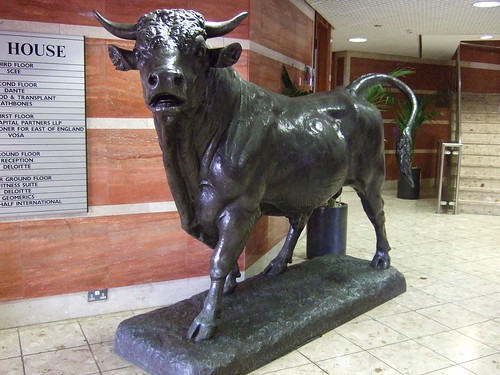
Cambridge bull sculpture
Isidore Bonheur, Bull, c.1878, bronze. Deloitte, Cambridge

What a remarkable revelation!

19th-century might and masculinity


Isidore Bonheur was a 19th-century French sculptor.  This means that these sculptures were imported from what was then the leading centre of the European art world  -- Paris.  Made during an era when this kind of sculpture was a central part of art-making.  Isidore Bonheur exhibited at universal and other exhibitions, and won a number of gold medals and awards.

These bulls express all the confidence of the 19th century.  They are big and brash and secular; they stride belligerently into a future of industrial and commercial promise.

They are part of a Europe that is at the height of its political and imperial power, full of arrogance and ambition and belief in its place in the world.


Isidore Bonheur, Detail of Bull, c.1878, Deloitte, Cambridge


But they speak to me also of other things:  of the price to be paid for being top of your game.  Of masculine braggadoccio and its flipsides:  anxiety about rivals, the need to be always one step ahead, patriarchal posturing with no real substance.
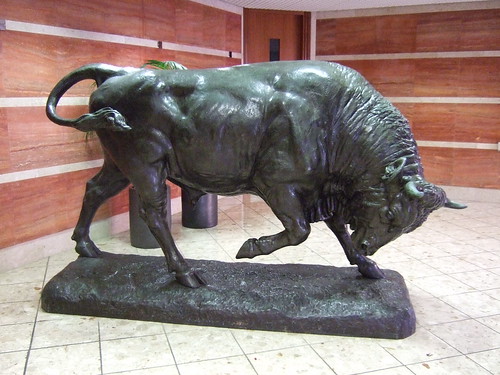

Cambridge bull sculpture
Isidore Bonheur, Bull Pawing the Ground, c.1878, bronze. Deloitte, Cambridge


Here's another remarkable fact:  Isidore Bonheur was the brother of Rosa Bonheur.


Rosa Bonheur


Rosa Bonheur was a hugely successful animal painter. She was also one of the few women artists to succeed within the artistic mainstream of the 19th-century.


Rosa Bonheur. Source: Les amis de Rosa Bonheur.


You can see her painting Horse Fair (1855) in the National Gallery in London:


Rosa Bonheur, Horse Fair (1855). Source: National Gallery, London.


Here is the Bonheur family:


Source: Le piéton de Paris.


Rosa Bonheur is seated and holds a print.  Isidore Bonheur stands behind her, with the snazzy ringlets above ears and forehead.  It was Rosa who apparently taught her little brother his first artistic skills.


Isidore Bonheur

What else did Isidore Bonheur sculpt?

Mainly animals.  And of those animals, mainly powerful prowling or prancing mammals.


Isidore Bonheur, Legionary on Horseback, Sainte-Anne Hospital, Paris.
 Source: Wikipedia,© Siren-Com.


Isidore Bonheur, Prowling Lioness. Source: Prices 4 antiques.


Isidore Bonheur, Lion and Mouse. Source: Live auctioneers.


And, what a surprise:  quite a lot of bulls.


Isidore Bonheur, Bear and Bull. Source: frbronze.


Isidore Bonheur, Rearing Bull with Handler. Source: Arcadja.


From Paris to Cambridge


Here is a version of our very own Cambridge bull:


Rosa Bonheur. Source: Wikipedia.


This bull is a public statue.  It's one of a pair.  They face each other across the entrance gate to the Georges Brassens Park in Paris.


Parc Georges Brassens, Paris. Source: Le piéton de Paris.

The bulls are reminders that this Park was once an abattoir.  According to Le Piéton de Paris, Rosa Bonheur used to visit this abattoir regularly, in order to study the animals for her own paintings.

The two Park bulls are based on the two bulls that Isidore Bonheur exhibited at the Paris Universal Exposition in 1878.  The one with the lifted head stood on what was to be the future west base for the Eiffel Tower, the other (the one with the lowered head) stood on the north base.  Brilliant pictures of these bulls at the Expo are at Piéton de Paris.

Universal bulls


Our Cambridge bulls are versions (copies? casts?) of those Universal Exposition bulls.  What an illustrious pedigree!

I wonder when Deloitte acquired them?  The Deloitte accountancy firm was founded in 1854, according to the Deloitte website; 1845, according to Wikipedia).  I don't know when they opened their Cambridge branch or when they bought these two bulls.  But I like to think that they purchased them in the wake of the Universal Exposition, in the late 1870s or early 1880s.  As a tangible symbol of their ambitions to be universally important.  (They opened their first New York office in 1880).

Two bulls in a Cambridge office lobby.  And such a fascinating history.  Who would have thought it?


Read more:


All about Isidore Bonheur: Wikipedia.

All about Rosa Bonheur: Les amis de Rosa Bonheur (in French).

All about the bulls in Georges Brassens Park, Paris: Le piéton de Paris (with fabulous pics; in French).

My first blog post about the Cambridge bulls: Cambridge bull sculptures.

Rosa Bonheur, drawing of a pony, Fitzwilliam Museum, Cambridge. Source: Fitzwilliam Museum.


Wednesday, 16 April 2014

Whatever happened to the Newmarket Road graffiti?

Remember the graffiti on Newmarket Road?  I blogged about it in 2012:  Graffiti on Newmarket Road.

It looked like this:

All graffiti by the Blight Society.


Well, that's all just a memory now.  Because it's gone.

Instead, we have:


What is happening on this building site?  There will be another new hotel.

One new hotel already exists, right next to the building site.  It's the new Travelodge.

Source of photo:  © Cambridge2000

The architects are Barber Casanovas Ruffles.  This firm designed a number of other buildings around Cambridge, including:

Portugal Street.  Source:  BCR

and:

Cambridge Water Company, Fulbourn Rd (Cherry Hinton - as you drive towards Tesco) Source:  BCR
This is what the architects Barber Casanovas Ruffles say about the Travelodge project on their website:

'The approved design satisfies the demands of this focal "Eastern gateway" to Cambridge City Centre and creates a vastly improved public realm with a generous new hard landscaped area to Newmarket Road.
The rigid budget hotel requirements and costings were carefully balanced with the Cambridge City's aesthetic demands.'

You know, I had no idea that Newmarket Road near the Elizabeth Way roundabout had morphed into an "Eastern gateway".  As far as I'm concerned it's still the ugliest road in Cambridge, and the worst approach to the town.  I also was unaware that Cambridge City had 'aesthetic demands'.

So I checked the Council website and discovered that yes, indeed, this area is referred to as Eastern Gate Study Area (sic).  The framework planning document does not mention the word 'aesthetic' but it does state its 'vision':

Regenerating and transforming this key approach to the city through high quality development coupled with key projects that will connect people and places.  (Eastern Gate Development Framework)
I'm very happy that somebody is devoting some tender loving care to this unlovely corner of Cambridge (somebody besides the Blight Society).  Although I do worry about the preponderance of commercial hotels.  It would be good to have a few more diverse and public spaces in the mix but given Cambridge City Council's history with disasters like the Cineworld complex or offices on the Hills Road railway bridge, I am not sanguine about any sort of imaginative urban planning.

The Travelodge sits next to where the graffiti used to be.  On the actual spot of the graffiti, there will be another new proposed hotel, a Premier Inn.

Edited to add:  An anonymous commenter (see below) pointed out to me that the new hotel will actually be on the other side of the Travelodge.  Sorry for the misleading error...!

  The Premier Inn will, apparently, look like this: 

Source:  Cambridge News June 2012

I couldn't find out the architects responsible for this hotel.  Does anyone know?


So what did people think of the loss of the graffiti?  Here's some vox pop.

And what do you think?  Are the hotels an improvement?

Related posts:

•  The murals in the tunnel under Elizabeth Way roundabout (just up the road from  the two new hotels)

•  Is there art in Arbury?  (Well, there's certainly graffiti by the Blight Society plus a Travelodge and a Premier Inn -- these two hotel chains seem to come in pairs)

•  The Snowy Farr statue (involvement from Cambridge City Council)

Have a lovely sunny April day!

Sunday, 7 April 2013

Street piano discovered in Oxfam, Mill Road


I was cycling along Mill Road when my eye was caught by this blue piano in the window of a charity shop.  

Hang on, I thought, I know this piano!


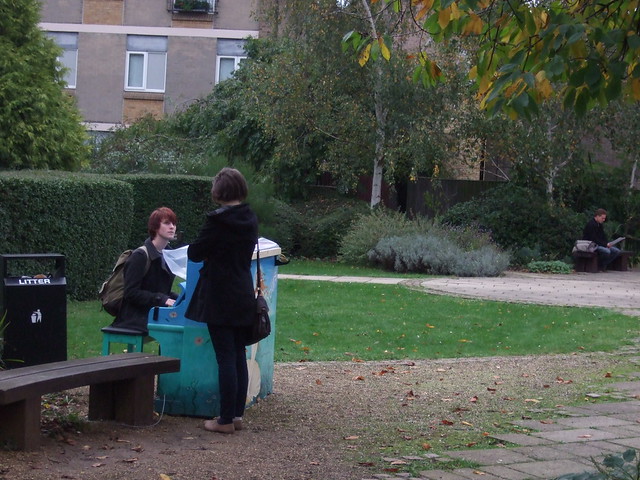
Yes! It's one of the 15 pianos from last autumn's piano street installation!  To be precise: it's the piano that was located in Ditchburn Place, off Mill Road.

Here it is, in October 2012: 


Recognise Botticelli's Venus?

I visited all of the pianos back then and took lots of photos:   15 things I learned from 15 street pianos

Oh, and on 8 March (International Women's Day), this street piano featured  in the show put on by the Cambridge Women's Resource Centre's art group.


Sally Lander who writes the lovely Yoga with your slippers on blog asked me 'Where do the street pianos go once the installation is over'?


Well, now you know!  (For at least one of them...)


What I didn't do was to ask if it's for sale.  Or how much it costs.

Does anybody know what's become of the other 14 street pianos?


Permalink:  http://artincambridge.blogspot.com/2013/03/street-piano-discovered-in-oxfam-mill.html

Related Posts Plugin for WordPress, Blogger...