Showing posts with label seasonal. Show all posts

Saturday, 19 April 2014

Happy Easter Saturday! or, The Harrowing of Hell

Have you ever wondered what Jesus Christ was doing in between his death on the cross (Good Friday) and his resurrection (Easter  Sunday)?

Well, he was down in hell.  Rescuing some of the worthy souls trapped down there and taking them straight to Heaven.  Eve, Abraham and Adam were all included.

This is called the Harrowing of Hell (or anastasis in Greek - I just love that word).
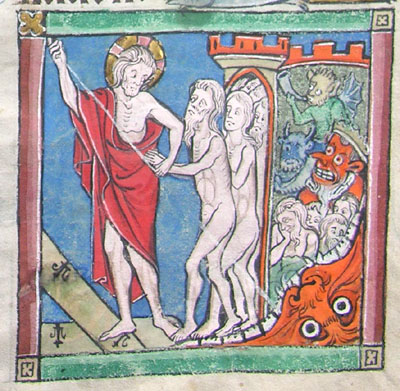

The Harrowing of Hell.  Manuscript illumination, from f.54r of MS K.21,
Canticles, Hymns and Passion of St Christ, late 13th/early 14th C.
Source:  Collection of St John's College Library, Cambridge


I'm not 100% sure of the iconography but it looks to me as if Christ is standing on the instruments of his torture (planks from the cross).  I don't know what the symbols on the planks stand for.  He's wrapped his red funeral shroud around himself, or that's what it looks like as he's not fully clothed.  And he's stabbing the Devil's mouth with a long spear-like thing which looks more like a shaft of light than anything physical.

Three souls (the middle one is surely Eve) come huddling out through the Gate of Hell.  I like the way Hell has turreted architecture.  And I love the way the naked humans are walking barefoot on the Devi's teeth.

Satan is angry red (but a different, more orangey red from the regal red of Christ's robe).  The eyes are big and bulging, as are those of a beak-nosed sub-demon baring his teeth at the divine intruder.  Two tiny comic-looking devils cavort in the background:  the blue horned one looks a bit like a cow, and the bat-winged one blowing his little trumpet seems to have jumped out of Maurice Sendak's Where the Wild Things Are.

Four more souls crowd together in Satan's maw.  One of them holds his face in his palm.  Their eyebrows and downturned mouths express desperate misery.  Are they among those about to be saved?  Or are their sins too great?

I like the ocular intimacy (a phrase I borrow from Mika Natif in her chapter in this brilliant book that I'm reading at the moment) between Christ and the foremost human (Adam?).  The anatomical detail is also great:  breast bones, clavicles, rib cages, diaphragms, calf muscles -- all carefully delineated.

Have a peaceful and happy Easter, everyone!


If you'd like to read more:
St John's College Library, mediaeval manuscripts

Icons and their interpretation: The Khora anastasis (great analysis of a brilliant Byzantine Harrowing fresco in the Kariye Cami in Istanbul)

Eat the bible (a sceptic's view)

Wednesday, 13 November 2013

Blog holiday


 Dear faithful readers

I felt that I owed you just a quick  post to explain my recent absence from the wonderful pages of this blog.  I'm taking a little blog holiday to devote myself to other parts of my life. Currently, these are 1.  my scholarly book on visual narrative in nineteenth-century European painting (which I hope to have ready for publication in the summer of 2014); and 2.  nanowrimo (National Novel Writing Month) which is consuming my spare hours this November (you write 50,000 of the first draft of a novel in one month - that's 1667 words a day).

Thank you for your patience!  I miss you, and I miss my blog but it's not going anywhere and will still be here when I'm ready to join the arty fray again.  Happy art discovering!

Have some autumnal pictures.  :-)

See you all around very soon.


Cambridge in autumn:  Bridge over the river Cam.  Sticky Beaks, Hobson St. Urban view.  Cherry Hinton Park. Jesus Green.

Thursday, 8 August 2013

Cambridge Gamelan to Celebrate Eid 2013 (or Idul Fitri, or Hari Raya)

It's the end of Ramadan 2013.  This day is called Eid by many but in Indonesia it is known as Idul Fitri, Hari Lebaran or Hari Raya.

I am not muslim but I grew up in Jakarta.  My childhood was accompanied by the sounds of muezzin calling over rickety loudspeakers, and I remember Idul Fitri celebrations in the city.  I could speak Indonesian before I could speak English.

So I want to celebrate today by having a look at a wonderful set of Indonesian artefacts in Cambridge:  the gamelan at the Music Faculty (University of Cambridge).  This particular set is called Duta Laras which means Ambassador of Hope.


Gamelan is the name of traditional Indonesian music.  It's also the name of the set of wood-and-bronze instruments, played by an ensemble of gamelan musicians.


Source:  Professor Roger Vetter's fascinating website on The Gamelans of the Kraton Yogyakarta

The picture above shows palace musicians on one of the gamelans in the Kraton (royal palace) of Yogyakarta, central Java.  These are among the most courtly, traditional and refined musicians in the world.

Watch a bit of their meditative mode of playing here:


The Cambridge gamelan is from Java and was gifted to the University by the Indonesian Embassy in 1983.  It's a court-style set of instruments which means that each instrument is duplicated across two scales: a five-tone scale and a seven-tone scale.

A gamelan set is made up of percussion instruments (vertical and horizontal bronze gongs, xylophones), drums that set the beat (kendhang), bamboo flutes (suling) and a wonderful, raspy string instrument called the rebab.  The rebab is fiendishly difficult to play and is often likened in versatility and timbre to the human voice -- to me, it's a smoke-filled human voice singing the blues.

Listen to this player first tune his rebab, then riff some tunes:


All the instruments:
Source:  CFS Worldmusic.


Note the snakes along the top of the frame holding the hanging gongs.  These are Naga Jawa, Javanese mythological snakes or dragons, with ornamental crowns, wide-open mouths and forked tongues.


Gamelan is a very old musical form that predates the arrival of Islam and even of Hinduism in Indonesia.  It appears on the 8th-century Buddhist temple of Borobudur.  Spot the drums (kendhang), the flutes (suling) and the string instrument (rebab).

8th-century relief from the Borobudur Temple, central Java (near Yogyakarta)
Source:  Wikipedia (Creative Commons Attribution- ShareAlike 3.0 License) © Gunkarta.

Gamelan integrates singing and dancing.  I learned to dance to Balinese gamelan music when I was a girl.

Young Balinese dancer (not me!)
Source: Learn NC

And later, when I moved to Cambridge, I joined the Cambridge Gamelan Society and played gamelan every week for a couple of years.

(I'm not in this picture, either...)

What does gamelan sound like?

For a taster, listen to some beautiful and tranquil Sundanese (Western Javanese) gamelan music called  Sabilulungan.


Watch the Malaysian Unimas gamelan group play a fun piece:


And finally, a rather snazzy modern gamelan celebration of Hari Raya / Idul Fitri in a Kuala Lumpur mall:


Read Joss Wibisono's interesting article on colonisaton and the influence of gamelan on Western music on his blog Gatholotjo.

The Duta Laras gamelan is kept in the Music Faculty on West Road.  If you want to see it, look out for the Cambridge Gamelan's next public performance (or play it, why not?  Contact the CB Gamelan Society).


Selamat Idul Fitri!  Eid Mubarak!  

Have a wonderful day, no matter your creed.


Other festivals on this blog:


Sunday, 31 March 2013

Happy Easter!

3023069_5de43cd9
Stained-glass window, King's College Chapel, Cambridge, c.1530.
©  Keith Edkins and 
licensed for reuse under this Creative Commons Licence.


On Easter Sunday, Christ emerges alive and resurrected from the tomb in which he was buried on Good Friday.  Where's he been these last 3 days and nights?  Well, some say that he's been down to Hell, pulling out people ripe for redemption:  people like Eve, Adam, Noah, Abraham, Isaac, Methuselah and the Queen of Sheba.

Here they all kneel, in grateful humility.  Christ steps on what appears to be a stylish blue trap door; in one hand he holds a triumphant flag; his other hand clasps the hand of Abraham.  The souls are naked, as befits souls.

"Oh, Death, where is thy sting?  Oh, Hades, where is thy victory?"
(1 Corinthians, chapter 15, verse 55, New Testament, King James Bible) 

Have a peaceful Easter Sunday, whatever your creed may be.

Other seasonal posts:

• Good Friday

• New Year

 Advent (Series:  How to look at religious art)


Friday, 29 March 2013

Good Friday


Alfred Wallis, Crucifixion,
or Allegory with Three Figures and Two Dogs
, 1932-4
photo:  © Kettle's Yard, Cambridge
Source: BBC Your Paintings

It's Good Friday.  Today, 1,980 years ago, Jesus of Nazareth was crucified on the cross by the Romans, at the place called Golgotha (or Calvary) just outside Jerusalem.

If you're interested, you can read about this in the Bible.  Try the New Testament, Gospel according to Matthew, chapter 27.

Alfred Wallis has changed the usual iconography in mysterious ways.  The man with the cap seems like a remnant of a Roman soldier.  But who are the dogs?  And why are two crucified men standing on top of one another?


Other seasonal posts:

• Christmas
• Durga Puja


Permalink:  http://artincambridge.blogspot.com/2013/03/good-friday.html


Friday, 8 March 2013

Happy International Women's Day!


Jane Bond, Fran Maranzi, motorbike dispatch controller, 2000
Jane Bond, Fran Maranzi, Motorbike Dispatch Controller, c.2000

To celebrate International Women's Day, here is a portrait of a woman, painted by a woman.

This is part of the absolutely amazing  People's Portraits collection at Girton College.  It's free to visit and open to the public every day.


The catalogue and the wall label quote Fran Maranzi in 2000:

"... there's nothing I like better than riding my 750cc Suzuki which can do 115 m.p.h.  She's been my pride and joy for 12 years."

The first International Women's Day was held in 1911, having been proposed by the German feminist and socialist politician Clara Zetkin.  In 1913, the day was moved to 8 March.

Permalink:  http://artincambridge.blogspot.com/2013/03/happy-international-womens-day.html

Friday, 25 January 2013

What's so great about the Cambridge mosque?


There's going to be a mosque in Cambridge, and it will look like this:

01cambridge mosque top


Controversy
This building proposal has not been universally welcomed. But what else is new?  Proposals of mosques to be built in European cities always generate controversy.

Cologne mosque controversy


Speaking solely from the point of view of architecture, my view is that this building will enhance Cambridge.  And here's why:


Five reasons why this mosque is an architectural win:


1.  Worshipper-win!

Finally, a mosque!  There are 7,000 muslims in Cambridge.


By contrast, worshipper-fail:


Currently, worshippers are crammed into a converted former chapel.

worshippers in old mosque


2.  Welcome-win!

This development is inclusive.  The mosque welcomes people in.  Not just women, but also men.  Not just Indonesian muslims but also Pakistani muslims, Saudi muslims, Lebanese muslims, Bengali muslims, muslims of all backgrounds. 

And not just muslims, but all of us other locals.

The architects propose:

As well as the community garden, the facility will include a cafeteria with a garden terrace, a teaching zone available for everyone in the community, and room for art exhibitions and performances of various kinds. 

cambridge mosque front
04cambridge mosque community garden


So: this mosque is for all of us.

By contrast, welcome-fail:

Many of the most famous Christian places of worship in Cambridge are not inclusive at all.  

For example, unless you're a card-carrying member of the University of Cambridge, you normally have to pay to get into King's College Chapel.

kings college entrance chapel


3.  Urban renewal-win!

In BilbĂŁo (Spain), the Guggenheim Museum transformed the urban space around it.  In London (England), Tate Modern did a similar transformation for south of the river Thames. 

Our new mosque will transform Mill Road (Romsey area).

What the plot used to look like:
Robert Sayle warehouse, Mill Road (Google map streetview screenshot)
Former Robert Sayle warehouse.  Screenshot via Google Streetview.

What the plot will look like:

06cambridge mosque view


By contrast, urban renewal-fail:


cineworld

Cambridge Leisture Centre


4.  Eco-win!

This is an eco-mosque.  It has heat pumps, water recycling and a sedum roof.

From the architects' proposal:

An innovative feature of the development is its ambition to become Britain’s first significant 'eco-mosque’' A range of sustainable features, including heat pumps, water recycling, natural ventilation and lighting, and a sedum roof, will make the structure a symbol of national excellence in environmentally-responsible engineering.


08cambridge mosque above


By contrast, eco-fail:


Source:  Worldarchitecturemap.org


5.  Aesthetic win!

It's beautiful, brave and bold.

Every new building should replace whatever's been there with something fabulously more beautiful.  

09cambridge mosque tiles
03cambridge mosque section


By contrast, beauty-fail:

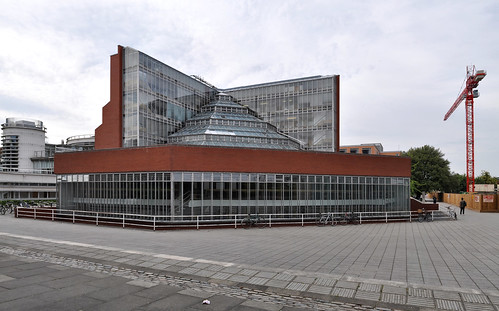
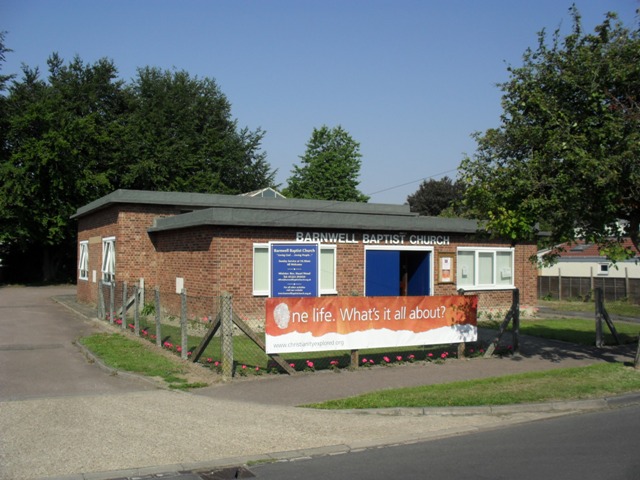
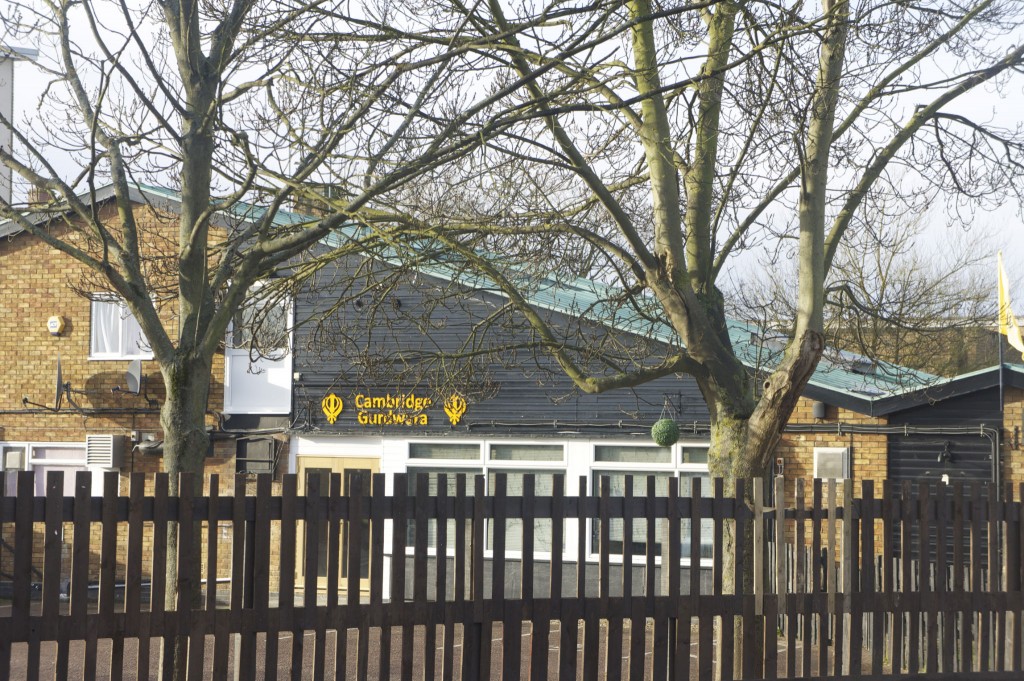
Some religious communities of Cambridge have to put up with some very undistinguished architecture.

This is where the Cambridge Traditional Jewish Congregation meets:

The Cambridge Jewish Student Centre.  Photo: © Ben Harris and licensed for reuse under this Creative Commons Licence.


This is Barnwell Baptist Church on Howard Road (in the Abbey area of Cambridge):


Source:  barnwellbaptistchurch.org


And the Sikh community meets at the Cambridge Gurdwara which is currently based in a former pub (The Grove, Arbury Community Centre, Cambridge):


Source: cambridgegurdwara.org


So, in sum: the promised Mill Road mosque is an architectural win all round!


Posted on the occasion of the prophet Muhammad's birthday (25 Jan 2013).  

Happy Eid-e-Milad-un-Nabi!  Happy Mawlid!


I'd love to hear your views on the mosque.  Comment below or tweet me!  


What:  Mosque on Mill Road, Cambridge.
Where: Site of former Robert Sayle warehouse, lower Mill Road.  Purchased by a charity headed by Yusuf Islam (the artist formerly known as Cat Stevens), in 2008. (See Public Arts Strategy, p.5).
Architects:  Marks Barfield

Other projects by these architects include the London Eye.

Garden designer:  Emma Clark. (She specialises in Islamic gardens.)


cambridge mosque garden fountain


Further reading:


Related posts:
Related Posts Plugin for WordPress, Blogger...