Showing posts with label critters. Show all posts
Wednesday, 20 April 2016
Downing College griffin sculpture
I discovered this griffin in Downing College. The plaque reads: 'This griffin was discovered in Sussex and presented to Downing College by [various people] to mark the golden jubilee of the Downing College Association, founded in [illegible].' (It was 1922.)
A griffin rampant appears on the crest of Cambridge's Downing College. Hence the connection to the alumni association.
It is covered in lichen. It looks like something out of an Elizabeth Goudge novel. There it crouches, clasping the scroll without script, poking out its tongue at passers-by. It has wings; lion-like claws, paws and haunches; dog-like ears; a curved eagle's beak; and sternly-staring eyes that are holes bored into the stone.
Griffin, griffin, wilt thou speak?
Wednesday, 6 April 2016
Crawling with Life: An exhibition of flora and fauna at the Fitzwilliam Museum
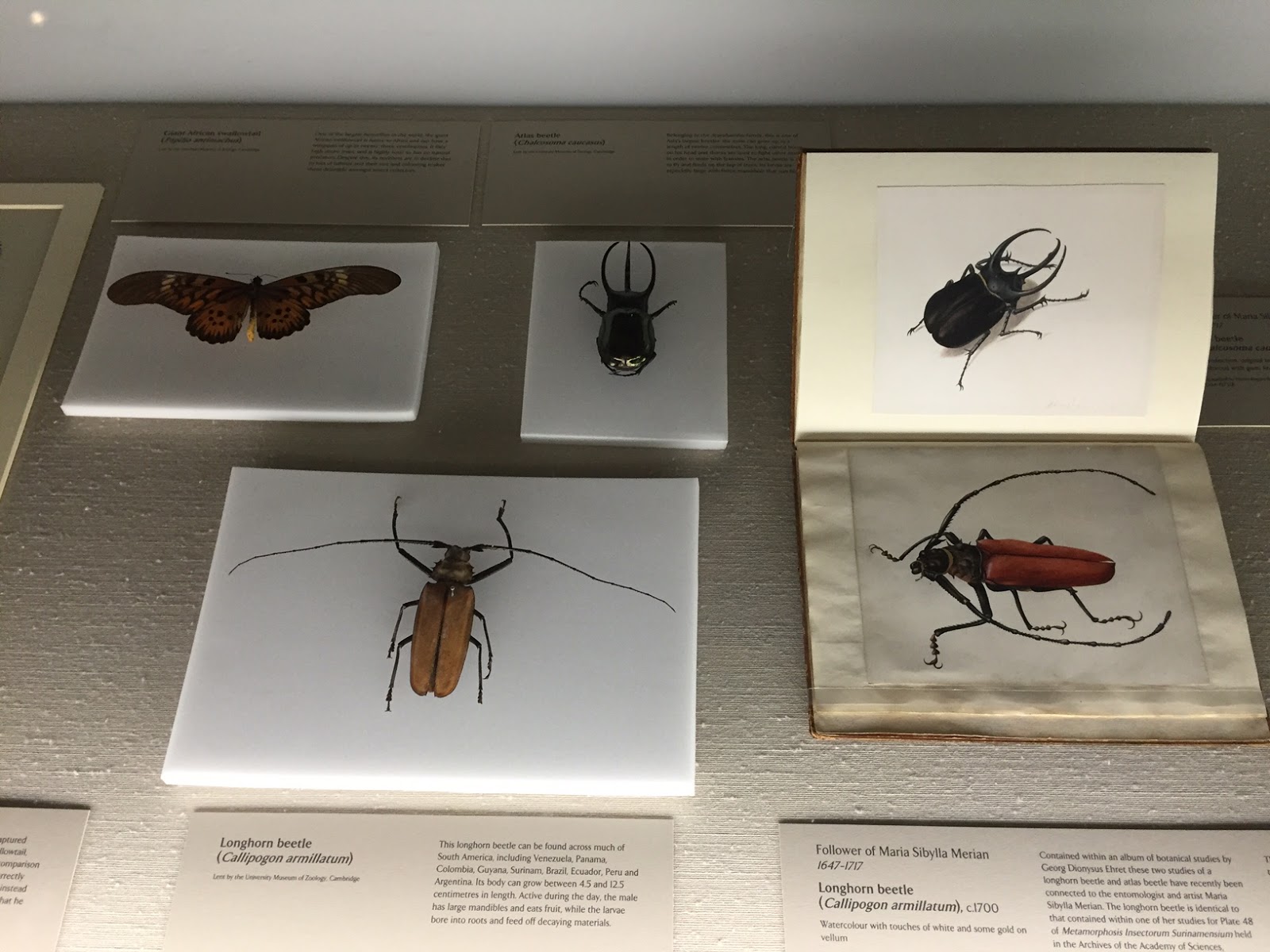
The first thing you see when you enter the small exhibition of 17th and 18th-century flower drawings, is a giant black beetle with three impressive-looking horns.
The beetle sits in a typical old-fashioned flora and fauna display case; it's pinned to a board in the classic way of a scientific specimen.
In fact, this beetle, alongside another beetle and a butterfly, have been borrowed from the Zoology Museum in Cambridge and placed next to watercolour images of themselves. It is as if we have the portrait and the sitter all in the same glass vitrine.
| Atlas beetle (Zoology Museum, Cambridge) and Follower of Merian, Atlas Beetle, c.1700, watercolour with some white and gold |
| Add caption |
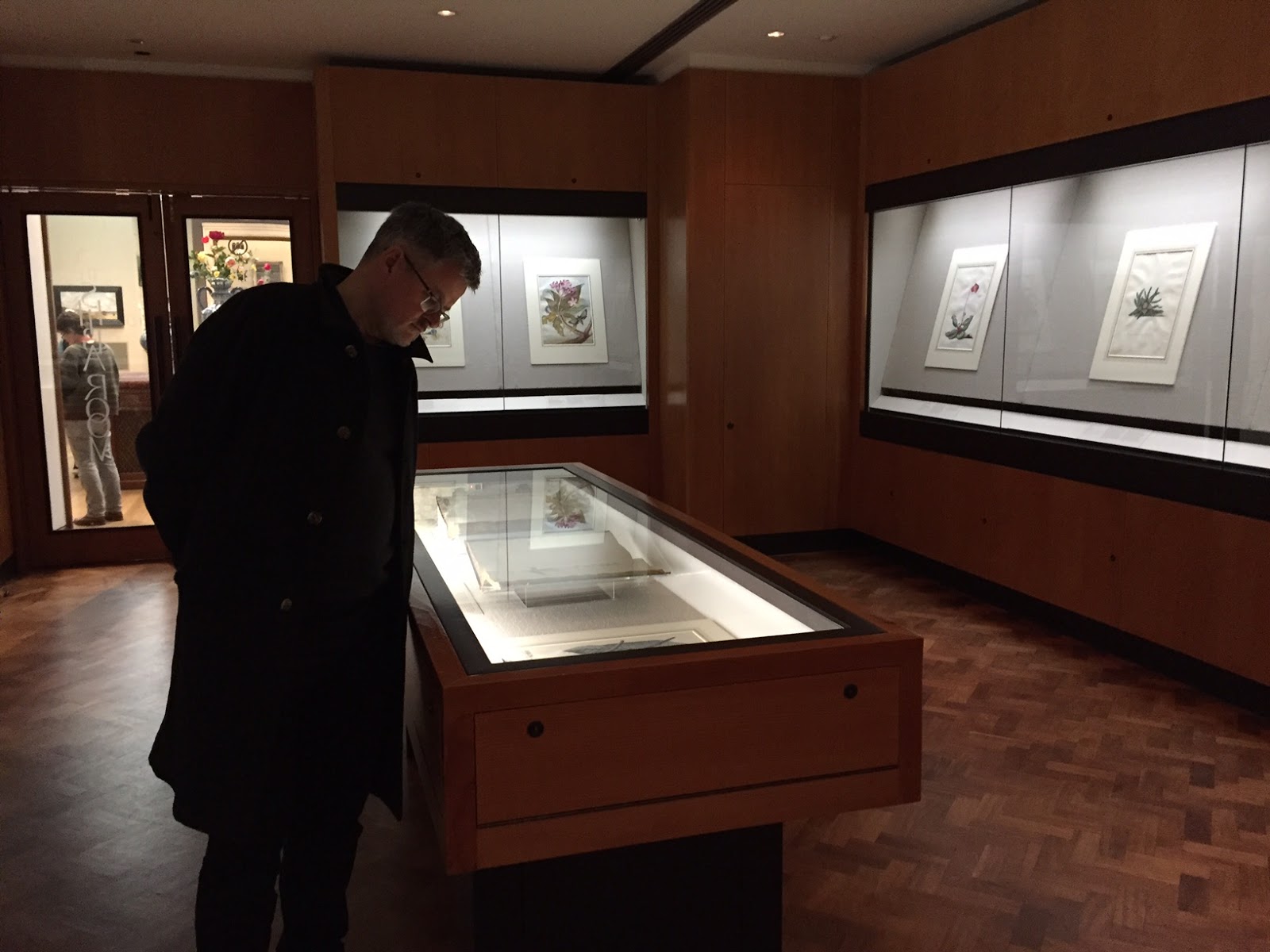
Is it art? Is it science? These distinctions blur in your mind as you peer at the displays.
![]() |
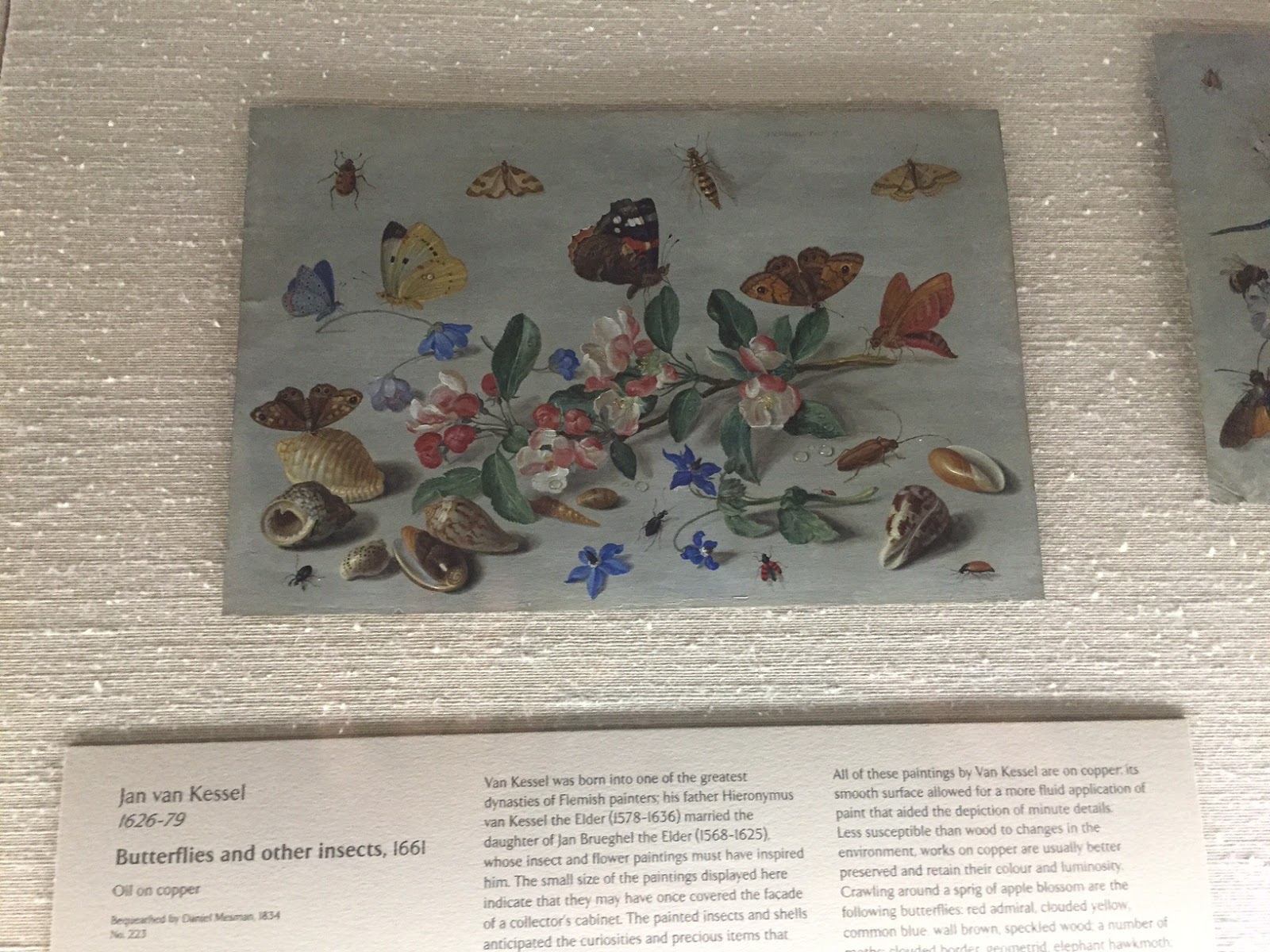
| Jan van Kessel, detail from Butterflies and Other Insects, 1661, oil on copper |
This Flemish artist, Jan van Kessel, got so carried away by the ecstasy of meticulous naturalism that he included transparent drops of water alongside his blossoms, shells and creepy crawlies. Look at the drops practically quivering on the leaves and on the pale blue-grey ground.
![]() |
| Add caption |
The white background is not entirely ubiquitous, though. Here is another woman, Margaretha Barbara Dietzsch, who, along with her brother, liked to use a black ground.
| Margaretha Barbara Dietzsch, detail from Common Dandelion with a Garden Tiger Moth, watercolour, bodycolour and gum Arabic, 18th C. |
A strange nocturnal world unfolds. It's almost a still life, almost a flower painting (like those in Gallery 17; see my blog post), but without the allegory, without the wilting leaves and the mementi mori. Yes, a quarter of the dandelion clock is blown away but the caterpillar climbs determinedly on. And everything is ripe with growth and bursting with life. These are not melancholy pictures. This is part science, part art, and 100% rhopography: the depiction of the trivial, the love of the humble.
Visit the exhibition Crawling with Life: Flower Drawings from the Henry Rogers Broughton Bequest.
Fitzwilliam Museum, Cambridge, Gallery 14.
Ends Sun, 8 May 2016.
It is totally worth seeing! It's small, too, so you won't exhaust yourself. And free!
Related blog posts:
Permalink: http://artincambridge.blogspot.com/2016/03/crawling-with-life-at-fitzwilliam-museum.html
Thursday, 22 October 2015
Three October art things in Cambridge
What art to see in Cambridge this month: My quirky picks
1) Shaggy Dog Stories, by Tom Hackett. Yellow dogs in wheelbarrows. On a balcony in the Lord Ashcroft Business building at Anglia Ruskin University on East Road. More about them on the surrounding walls. You can touch them! They feel sort of slimy, like dry soap.
2) Kerstin Hacker's haunting photographs of births, babies, midwives and mothers on a Czech maternity ward. Strange, beautiful, sad, wrenching. At Changing Spaces, that little gallery next to CB2 on Norfolk Street.

Ends 1 Nov.
3) Oh, and my own talk at the Festival of Ideas on Saturday, 24 Oct, at 2 pm. :-) Come along to the Fitz and join me for Power and Resistance in Sculpture in the Aftermath of World War One.

http://www.festivalofideas.cam.ac.uk/events/power-and-resistance-sculpture-aftermath-world-war-one
Month: October 2015
Place: Cambridge, Cambridgeshire
Tuesday, 30 April 2013
Cambridge critters: Artificial arthropods
Cambridge creepy-crawlies
| Three Dung Beetles, by Wendy Taylor (2000). Bronze. New Hall Art Collection. |
When I first posted pictures of Wendy Taylor's fabulous Dung Beetles, I had two enthusiastic responses from my yoga class. So I was inspired to find more creepy-crawlies in Cambridge: insects, arthropods, all manner of scuttling, segmented and armoured invertebrates.
Enjoy them!
| Grasshopper, by Matthew Lane Sanderson (2006). Steel. The Greshams, Gonville Place (facing Parker's Piece). |
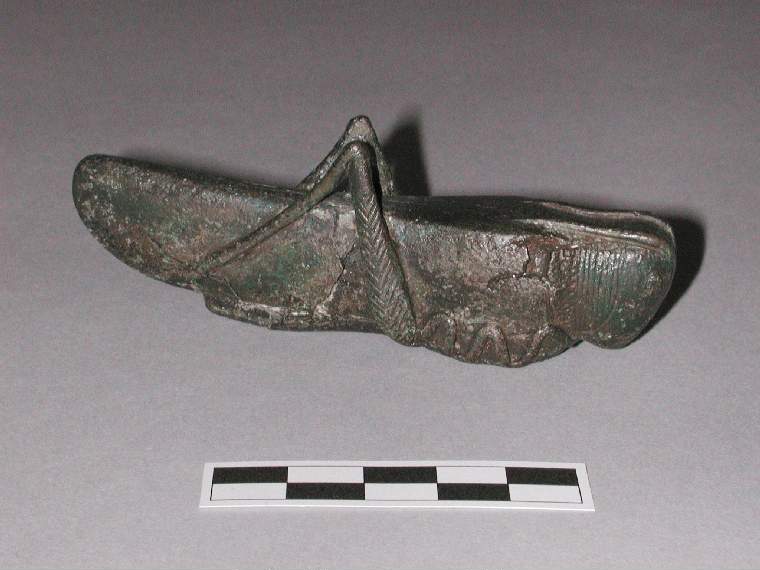
| Locust. Egyptian (c. 660-330 BC). Ancient Egyptian. Photo © Fitzwilliam Museum. |
| Print of a spider by Helene Fesenmaier. From the exhibition at Trinity Hall in Nov. 2012. |
Filigree spider.
| Bee detail, from Mapping the Waters by Amanda Lebus (2003). Pencil on paper. New Hall Art Collection. |
I love bees and am so sad that they're so rarely seen now.
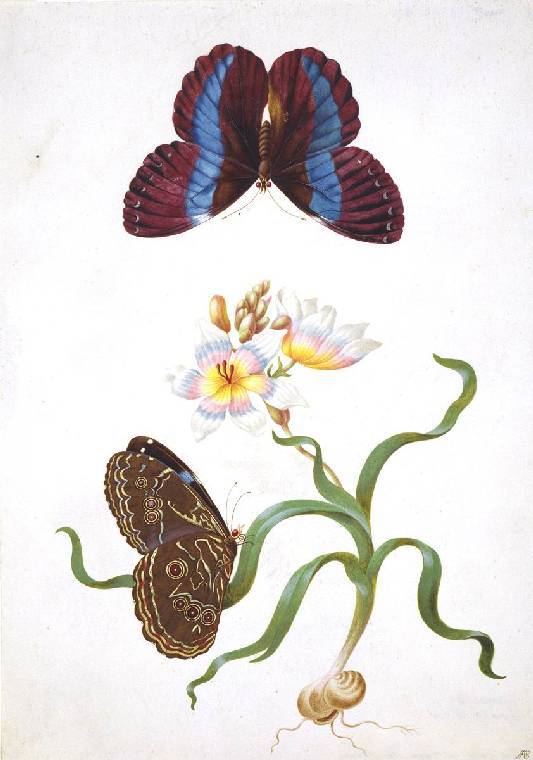
| Sisyrinchium with a Purple and Brown Butterfly by Maria Sibylla Merian (lived 1647-1717). Watercolour on vellum. © Fitzwilliam Museum. |
| Embroidered moth, detail from a North Chinese wedding dress (jacket, skirt and hairband). Museum of Archaeology and Anthropology. |
| Detail of a page in John James Audubon's volume Birds of America (1827-1838). Cambridge University Library. |
| Beehive (1899). Relief plaque from the old Co-op 'Stop-and-Shop' store, now Primark. Burleigh Street. |
Not so much an insect as an insect's home. The beehive has been a symbol of the Co-operative movement since the 1860s and can be found on quite a few Co-ops around the country. The Beehive Shopping Centre in Cambridge is so-named because there used to be a big Co-op on that site. Read more about Co-operative symbolism at the Public Monuments & Sculpture Association.
| The Cobwebs. House at 4 Gresham Road. |
Another home without its inhabitants. Where have all the arachnids gone? (This one comes to you courtesy of my son who remembers it from his days at kindie round the corner.)
| Lobsters in a corridor of the Fenners Building, part of Hughes Hall. Seen from outside the carpark gates in Mortimer Rd. |
| Grasshopper (or Chronophage) by Matthew Lane Sanderson, on top of the Corpus Clock (2008). Gold-plated stainless steel. Corpus Christi College, Corner Bene't St and King's Pde. |
This post is for Sally and Jane. ;-)
Permalink: http://artincambridge.blogspot.com/2013/04/cambridge-creepy-crawlies-three-dung.html
Wednesday, 14 November 2012
Dung beetles at New Hall
There they are, at the bottom of a spiral staircase: three dung beetles.
They are large and dark and arranged in a triangular pattern. They have antennae and six spindly, spiny legs. Their folded wings are a striped carapace. The rest of their armour is pebbled with a seed-grain texture that contrasts with their smooth faces. (Can you call them faces?)


They are a group of sculptures (much like the Chapman brothers' dinosaurs at Jesus College). They are not on a plinth.
They seem a bit menacing, half abstract design, half sinister creepy-crawly. They are much larger than any beetle has the right to be.

But they are also fun, lurking in the basement, and not everybody finds them creepy. Ruth Allwood is the catering manager at Murray Edwards College where the beetles live, and she says:
"My favourite pieces of artwork are the bronze beetles at the bottom of the Dome staircase. [...] I always pat one of them as I go past." (Read the rest at the New Hall website.)
Wendy Taylor made the bronze beetles in 2000 and donated them to the New Hall Art Collection. This was not the first time Taylor sculpted dung beetles. Here are some she did for London Zoo:
Dung Beetles, 1999, London Zoo
Another of her beetles was stolen in 2005/06 along with 20 other bronzes around London.
Cambridge has one other sculpture by Taylor; this one doesn't look like a beetle at all:
Jester, 1994, Emmanuel College, Cambridge
Source: Reggie's photo blog
Title: Three Dung Beetles
Artist: Wendy Taylor
Date: 2000
What: Bronze sculpture
Permalink: http://artincambridge.blogspot.co.uk/2012/11/dung-beetles-at-new-hall.htmlSunday, 30 September 2012
Looking up at Cambridge buildings
Critters and columns
I was walking through Cambridge, and then I looked up. Once I had discovered my first few surprises, I went actively looking for more. Here's what I found:
| Hello! |
| Corpus Christi, corner Bene't St / Kings Parade |
| Lloyd's Bank, corner Sidney St / Hobson St, Victorian |
| OLEM (seen from the parking lot on Lensfield Rd) |
And who is the weary cleric with a biretta on his head?
| 19 King's Parade |
The Moving Finger writes; and, having writ,
Moves on; nor all your Piety nor Wit
Shall lure it back to cancel half a Line,
Nor all your Tears wash out a Word of it.

I am a plaster boar! With a crown!Moves on; nor all your Piety nor Wit
Shall lure it back to cancel half a Line,
Nor all your Tears wash out a Word of it.
I wonder who carved this plaque, with its long-legged Rs, tendrils and bowl of round fruit?
| 18 King's Parade, hipped dormer, 16th C. |
| King's College, gatehouse (neo-Gothic, 1824) and chapel (late Gothic, 15th-16th C.) |
King's College: The most famous skyline of Cambridge.
The architectural historian Nikolaus Pevsner spoke of the 'bulbous cupola' of the gatehouse -- a description I rather like.
| Old Schools, Free Lane, South Building, seen from courtyard / parking lot |
More creatures on a Cambridge cornice. What are they doing? The left one curls his long tail around the bird-like feet of the right one -- to stop it from flying away?
Is this love on a ledge?
| 6 Little St Mary's Lane, 2001 |
The 'boar house' has pargeting on its walls in the shape of shells.
| Cintra House, Hills Rd (Open University), cameos after 1865 |
| Corner Sussex St / Sidney St |
| Maitland Robinson Library, Downing College, 1993 |
| This astronomy dish symbolises one of the subjects taught at Cambridge University (physics?). The architect is Quinlan Terry, guru of classical revivalism and much beloved by Prince Charles. |
| Cambridge railway station, 1845, medallion |
The train station is based on the 15th-century Foundling Hospital in Florence, with its arches and its round medallions. This medallion shows the coat of arms of Pembroke College. Don't you like the little red birds? They are martlets.
| St Botolph's, church tower, 15th C. |
| Senate House, 1730 |
| Pediment, Fitzwilliam Museum, by Charles Eastlake, 1840 |
| HMV, Fitzroy St, formerly Laurie & McConnal's store, 1903 |
| Built 1930, Hobson St, formerly Central Cinema, Odeon Cinema and Gala Bingo Hall |
| Law Faculty, 1995, by Norman Foster, Sidgwick Site |
| Pasty shop, Market Hill |
Let's end with a repeat of my favourite round-eyed building beast:
What can you see when you look up?
Subscribe to:
Posts (Atom)