Showing posts with label science festival. Show all posts

Wednesday, 30 March 2016

Five Arty Things in April: What's on in Cambridge


After a hiatus: the return of the 'What's On' post!

Here's my personal pick of five arty things to do in Cambridge in April:

1.  Hide and Seek: Looking for Children in the Past
MAA (Museum of Archaeology and Anthropology)

I love the MAA.  In 2013, it was shortlisted in the final top ten for the Art Fund Prize of Museum of the Year.  In December, one of their curators won an award to build a collection of contemporary art works from indigenous communities in India (we wait for this exhibition with excitement; it will open in 2017).  And it is all round a fabulous place.

I look forward to seeing this exhibition.  It is free.  Opening times on the poster below.


2.  Generation Painting: British art 1955-1965
Heong Gallery, Downing College (just past the Porter's Lodge, to the left as you enter from Regent St)

The newest addition to Cambridge's art scene, and the only truly modernist and contemporary art gallery in town right now (while Kettle's Yard remains closed for refurbishing).  The present exhibition is brilliant and includes a wonderful painting by David Hockney.  The architecture and the setting are also really worth experiencing.  

Opening times:
Wednesdays: 10 – 8 pm
Weekends and bank holidays: 10 - 6 pm

It is free.
Ends 22 May 2016.

Coming up next: Ai Wei Wei!  Quentin Blake!

Follow the gallery on twitter:  @heonggallery

Watch out for my blog post on the gallery; it will soon appear here:  
http://artincambridge.blogspot.com/2016/03/british-painting-at-new-heong-gallery.html


3. New Hall Art Collection: Feminism and Gender
Murray Edwards College (the college formerly known as New Hall, up on Castle Hill)

My favourite art collection in Cambridge so of course I will include it in my first What's On post in months.  I've blogged about this collection several times before.

It's free, it's amazing, and it's open nearly all the time.
Alexis Hunter, Fear of the Intellectual Wife, 1987; source:  NHAC

4.  Conflicted Seeds + Spirit
The new David Attenborough Building, New Museums Site (accessible via Downing Street and via Corn Exchange Street which is that weird street behind the Grand Arcade with entrances to the car park and to the cycle park)

An installation by the artist duo Heather Ackroyd and Dan Harvey.  I look forward to seeing this, and (bonus!) to sneaking a peak at the brand new David Attenborough Building which is the old Arup Building, refurbished by architect bureau Nicholas Hare.


Opening times:  Wed–Sun, 10am–5pm
Ends 17 April 2016.


Source:  © Ackroyd & Harvey

5.  Crawling with Life:  Flower Drawings at the Fitz

Watch out for my review of this exquisite exhibition; it'll be posted next week!

Fitzwilliam Museum; ends 8 May 2016.


Enjoy your April!

Thursday, 6 February 2014

Sneak preview: Arty events at the Science Festival 2014


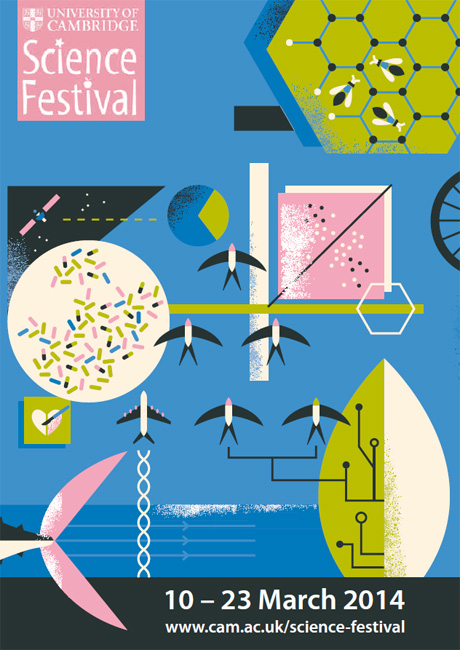
University of Cambridge Science Festival, 10 - 23 March 2014


Plan ahead for arty events at this year's Science extravaganza.  Lots of interesting non-art stuff as well.  Visit the
Festival website to pre-book.  Most events are FREE!

Visual art

Fiji exhibition.  Source:  MAA.

Art and Power in Fiji
Museum of Archaeology and Anthropology, Downing Street. 
Exhibition open Tues-Sun.  Guided tours on Fridays 14 and 21 March, 3 pm (pre-book).  Talk on how decorative patterns make the objects powerful, Thurs 20 March 5.30 pm (pre-book)
The first exhibition on Fijian art outside of Fiji.

Fijian Barkcloth
Small Exams Hall, Arts School, Bene't Street.  Sat 15 March, 11-4 pm.
For the first time in a generation, a large pice of barkcloth from the Museum of Archaeology and Anthropology will be on display.


Abraham Ortelius' map of Iceland published ca. 1595.  Source:  UL Cambridge.

Pictures, Perspectives and Plans
Cambridge University Library, West Road.  Tues 11 March, 5.30 pm.  Pre-book (free).
Learn about changing styles in cartography and view examples of maps from the 15th century to now.


Painting with the Earth
Sedgwick Museum of Earth Sciences, Downing Street.  Wed 19 March, 7 pm.  Pre-book
Spike Bucklow of the Hamilton Kerr Institute (one of the world's leading institutes in the conservation of paintings) talks about natural mineral painting pigments over the millennia.


Exhibit at the Wellcome exhibition.  Source: CB University


Wellcome Image Awards

Ruskin Gallery, Anglia Ruskin University, East Road (entry also via corner Collier Rd / Mackenzie Rd). 

Exhibition Mon-Sat.  Private View Thurs 20 March, 5 pm, with a talk by the Wellcome Trust at 7 pm.
See images that bring to life medical discovery, from microscopy to illustration. 

ABOUTNESS
Live art performances in response to neuroscientific research, incl. painting, drawing, video installation, in situ drawing and live art performance.  Pre-book.  £3.
Venue to be announced: check the booking page.


Display at the Sedgwick Museum.  Source:  University of CB, Museums and Collections


The Art and Science of Curation

Polar Museum, Lensfield Road.  Thurs 20 March, 6 pm.  Pre-book.


Join a panel of curators as they explore the definition and role of curation across arts and sciences.  Presented by University of Cambridge Museums.


Egyptian Blue: The First Synthetic Pigment
Fitzwilliam Museum, Trumpington Street.  Wed 12 March, 1.15 pm.
Find out about making and investigating this pigment; run by two conservators (Antiquities).

Conservation Conversations
Fitzwilliam Museum, Trumpington Street.  Fri 14 March, 5-7 pm; Sat 15 March, 2-4 pm.
Listen to talks on how objects are conserved and preserved.

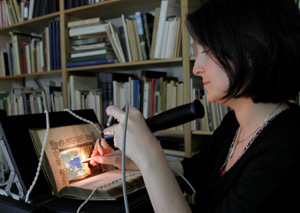
Infrared technology at the Fitz.  Source:  labbulletin.

Infrared Light on Manuscript Illuminations
Fitzwilliam Museum, Trumpington Street.  Wed 19 March 1.15 pm.
A presentation by the research associate (Manuscripts and Printed Books).


Photography

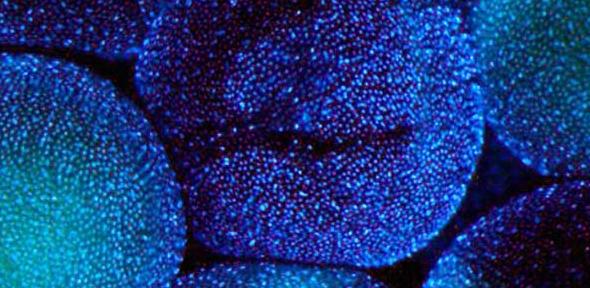
Human Lymphocyte by David ScharfSource: Royal Photographic Society.

International Images for Science Exhibition 
ArtCell Gallery, Cancer Research UK, Li Ka Shing Centre, Robinson Way. 
Exhibition open Mon-Fri.
See scientific photographs showing images from distant galaxies to subatomic particles.  Also an opportunity to discover this little-known venue (I hadn't heard of it).

Engineering Captured on Camera
Michaelhouse Café, Trinity Street.
Exhibition open Mon-Sat.
See entries from the University of Cambridge Department of Engineering photography competition.


Source:  Cambridge Science Festival.


Does any of this tickle your fancy??  Please comment below!

Friday, 22 March 2013

Audubon's Birds of America in the Cambridge University Library


audubon blue birds with grub


Twenty of us gathered round five tables pushed together at the University Library.  On the tables:  two volumes of John James Audubon's Birds of America, published between 1827 and 1838.

These books are extremely rare (only 200 or so copies exist), extremely fragile (ordinary readers cannot usually ask to see them), and extremely huge.  It takes two assistants to turn the pages, and each time they do so, the paper crackles.  The size is called 'double elephant folio' -- a very unusual and very expensive format.

audubon the whole book


Ed Potten, Head of Rare Books at the Cambridge University Library, gave a brilliant talk on the books.  Here's what I learned:

The Birds of America contains 435 plates in total.  Each plate is based on a watercolour painting by Audubon.  The watercolours were initially engraved onto copper plates by the renowned Edinborough firm of W.H. Lizars.  But most of the watercolours were transferred to print by the London printers R. Havell & Son who used the newly rediscovered aquatint process.  The 13-year-old John Mason painted 50 of the background scenes.


audubon turkey page ed potten
Ed Potton reads out information about Audubon.  The volume is opened to the turkey page:  the bird is life size!


audubon detail grasses leaves
At bottom right, it reads 'Engraved by W.H. Lizars Edin'


Each plate is hand-coloured with watercolour.  This means that all the copies differ slightly from each other.


audubon birds with red hair


audubon owls


audubon hawks


Ed Potten opened an earlier book for us to show us how Audubon revolutionised wildlife illustration.  This Histoire naturelle des oiseaux (1771) shows static birds:

1771 histoire naturelle des oiseaux
From the 1771 Histoire naturelle des oiseaux (Natural History of Birds)


By contrast, Audubon's illustrations are action-packed.  Here a rattlesnake attacks a mockingbirds' nest.  He has turned 'scientific' imagery into an exciting story.


audubon rattlesnake mockingbirds


audubon rattlesnake page


Critics complained that such scenes were not realistic.  How would a rattlesnake manage to climb up so high?

But it's a bit like the dinosaur art at the Sedgwick Museum:  ultimately, we don't care that it's not realistic.  We want drama and beauty in our art.

It's odd that Audubon's plates are so dynamic -- considering that he did them from dead birds.  Audubon collected his specimens by going out and shooting them.  It wasn't unusual for him to come home with 50 dead birds in a day.


He then dissected and stuffed the birds.  His studio was crammed full of these stuffed birds.  One visitor noted that Audubon's house smelled of "dead meat".


audubon bird and deer head

audubon detail grass bird and deer head


Audubon's watercolours still exist:  the New York Historical Society owns them.  The copper plates, though, were destroyed in a fire.  The Birds of America was a publishing sensation, and the smaller version of it a bestseller.

What a privilege to have seen these lavish, rare (and completely insane) objects of material beauty.  Thank you, Cambridge Festival of Science!


audubon yellow bird


More information:
The Birds of America page at Wikipedia
The Birds of America page at the National History Museum (London)


More at this blog:
Arty events at the Science Festival 


Permalink:  http://artincambridge.blogspot.com/2013/03/audubons-birds-of-america-in-cambridge.html

Monday, 18 March 2013

Behind-the-Scenes at a Science Museum: Behind every great dinosaur, there's a great artist

Compsognathus 1

On Saturday, I went to the Sedgwick Museum of Earth Sciences, as part of an outing to the annual Cambridge Science Festival.

But (pssst) I was not interested in the science.  I was on the hunt for art.

Because here's what I discovered:

Nobody's imagination is fired by bones neatly arranged by palaeontologists.

bones


Nobody's imagination but the palaeontologists' themselves, of course!

laura dern and sam neill in jurassic park
Dr Sattler and Dr Grant (Jurassic Park)

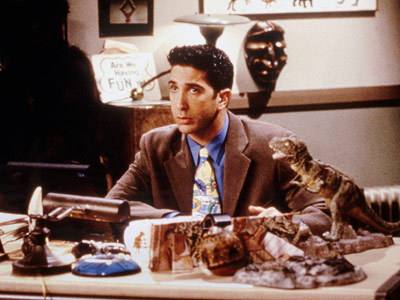
 Dr Ross Geller (Friends)


The rest of us, it seems, need blood and guts, T-rexes tearing herbivores limb from limb, Jurassic reptiles anachronistically attacking humans, and general monster mayhem.

We want our fossil digs to be transformed into exciting figurative stories.

© Errol Swanepoel, photo of West Coast Fossil Park dig

Enter Bob Nicholls.  

Bob Nicholls is a "palaeoartist" who paints pictures and murals, makes 3-D models and works with multi-media.  You can hear him talk about his life as a dinosaur fanatic at the Sedgwick Museum on Thursday, 21 March!  I have a ticket and look forward to an evening of tooth, tusk and claw.

Robert Nicholls, T-rex


And enter Richard Hammond.

This model of a Compsognathus longipes was made by Richard Hammond.  Richard Hammond is now a 'senior character artist' for computer games at Lionhead Studios in Guildford.  But in the 1990s, he was a natural history model maker.  (I had not even realised that either of these artistic careers existed...!)

The museum label explains:
"We do not know if Compsognathus had down, bristles or feathers, but the patch of elongate scales over the shoulders (greenish in the model) have been placed there to highlight this possibility."
The grammar is ambiguous but I'm assuming the 'possibility' refers to feathers.  Hello, raptor bird.

Compsognathus longipes, by Richard Hammond

Compsognathus 2


An 1820s vision of 'Ancient Dorsetshire'

Then there is the fantastical painting by local artist Robert B. Farren, based on the even more fantastical sketch by the geologist Henry De la Beche.  I have loved this painting for years.


Sedgwick Museum


Henry Thomas De la Beche, Life in the Jurassic Sea


jurassic 03

jurassic 02


Portrait of the geologist as an elderly man


The same painter, Robert B. Farren, also produced this portrait of Adam Sedgwick, pioneer geologist, for whom the museum is named.   It hangs above cabinets full of little stones and shells.  Sedgwick wears the robe of a scholar of Trinity College.  I like the way his hand spans the entire Earth.


Robert B. Farren, Adam Sedgwick

3-D Sedgwick


Here is Adam Sedgwick again, as a life-size sculpture, looking benevolently down at us from his niche.  He holds a hammer and a fossil.  I wish I knew who the sculptor was.

Adam Sedgwick


Adam Sedgwick face

Adam Sedgwick fossil

And Darwin, too

A bust of Charles Darwin hovers high up on a wall.  The sculptor is Anthony Smith who also made the Darwin sculpture in Christ's College.

Anthony Smith, Charles Darwin bust 2009
Anthony Smith, Bust of Charles Darwin, 2009 (commissioned for the Darwin bicentenary)

Darwin bust in loco


Vitrines are beautiful, too


Earlier I said that our imaginations are not fired by bones and stones.  But this is not entirely true.  The old Victorian glass cases with their hand-lettered labels and geometric patterns have their own aesthetic charm.

Inferior Oolite (Sedgwick Museum)

shells Sedgwick Museum


Jannis Kounellis knows this:

Jannis Kounellis, from his 2002 exhibition at the Contemporary Art Museum Ghent


More on Cambridge dinosaurs:  Dinosaurs by the Chapman brothers

Permalink:  http://artincambridge.blogspot.com/2013/03/behind-scenes-at-science-museum-behind.html
Related Posts Plugin for WordPress, Blogger...