Showing posts with label how to. Show all posts

Monday, 10 March 2014

How to bid at an art auction: My day at Cheffins Auction House, Cambridge

s

On Sunday, I visited Cheffins Auction House in Cambridge.

It was the first day of the 'viewing'.  This is when people who want to bid for something at auction go to inspect the objects.  Of course, you can also go if you want to buy nothing and just have a look around.

The room was full of paintings, prints, drawings, pieces of furniture and fittings, stuffed animals, jewellery and other objects.

a


The art is not labelled, as it is in a museum or gallery.  Instead, each item has a number attached to it.  This is the 'lot' number, and in an auction house, each individual item is called a 'lot'.

sf


For example, this charming leaf from the Persian poems of Hafiz is Lot 570.

photo 1


The place was crowded.  People milled about, peering at the art, bent over the jewellery cases.  They were mostly middle-aged and well-dressed.  One had a dog in tow.  I didn't want to take photographs of strangers so this snapshot of legs must suffice to give an impression.

wer

There was a little tea room, too.  I had no time to sip a tea but it looked very inviting.  The viewing was only for 2 hours.

photo

The sales catalogue was on sale for £10 but a few sale room copies were lying around for consultation.


photo 5

When you open up the catalogue, this is what you see:  every item illustrated, with its lot number and a brief description.

photo 3


Below, for example, is the catalogue entry for a lovely landscape painting by an artist called Clarence Henry Roe.  It's Lot 458.  The catalogue tells me the name, dates and nationality of the artist, the painting's title, medium and dimensions, and lists any inscriptions, such as a signature.

The catalogue also gives the work's provenance, that is, where the work comes from.  This painting was in a private collection in Scotland before it arrived in Cheffins sales room.

Right at the bottom is the price.  This is the 'reserve' price; if several people bid for an item, the price could well end up higher than this.

photo 4


Here is the landscape painting by Clarence Henry Roe as it was displayed in the sales room.

photo 2b


Bid forms were lying around the viewing room.

What you fill in:  auction date and title, your name, your company name (if you have one), your address, your phone number and your email.

Then you write down the lot number that you'd like to bid for, copy down the description from the sales catalogue, and write down your maximum bid.  (This is the highest amount that you are prepared to pay.  If bidding goes up any higher, you don't want to buy the item.)

Once you've handed this in, you'll be given a client number.

photo 1a

I was nervous about submitting a bid there and then.  I wanted to think about it some more so I went home, thought about it for two days, and then went on-line to submit my bid via the web.

Here is the auction's web page:


cheffins online cat page


Everyone can look at the sales catalogue.  But before you can enter a bid, you have to register with to the auction house website, with your name and contact details. You then sign in with a password.

Here's a screen shot of the bidding page for the landscape painting by Clarence Henry Roe I looked at earlier.

There are fields that you would complete if you wanted to bid for this painting:  the amount of money that is your maximum bid, your email and phone number.

The estimate for this painting is £200 - £300.


cheffins your bid


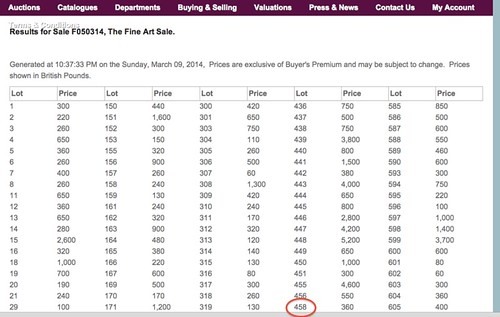
I didn't attend the auction itself as I had to work.  But I did check how it turned out afterwards.  The screenshot below shows that the Clarence Henry Roe landscape (Lot 458) sold for £360.
Untitled2


By the way, I didn't get the work I'd bid for...  Better luck next time!  I'll definitely try this again.  It was super fun!

I used to think auctions meant women in fur coats, Van Gogh paintings sold for millions of dollars and James-Bond villains lurking behind the pot plants.  But no!  It can be something much more accessible!

Have you ever bought anything at an auction?  I'd love to hear from you in comments.  Click on the little pencil icon below.

Links:
Visit Cheffins Auctions.

Follow Cheffins on twitter: @CheffinsFineArt

Art bidding for beginners (a 2011 article by journalist Jonathan Gornall)


Thursday, 13 February 2014

How to look at a sculpture (in Jesus College)

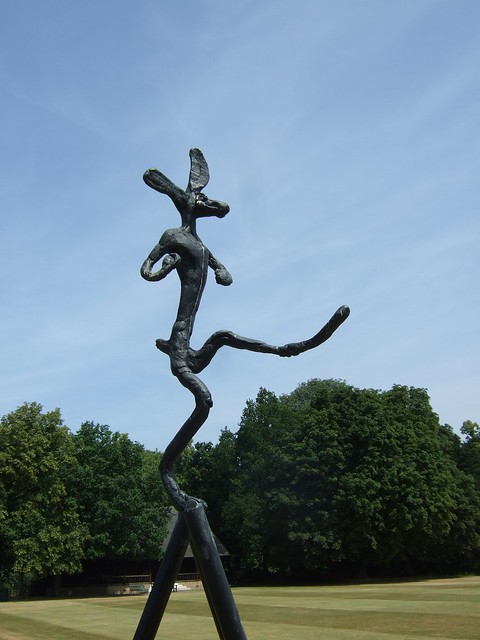
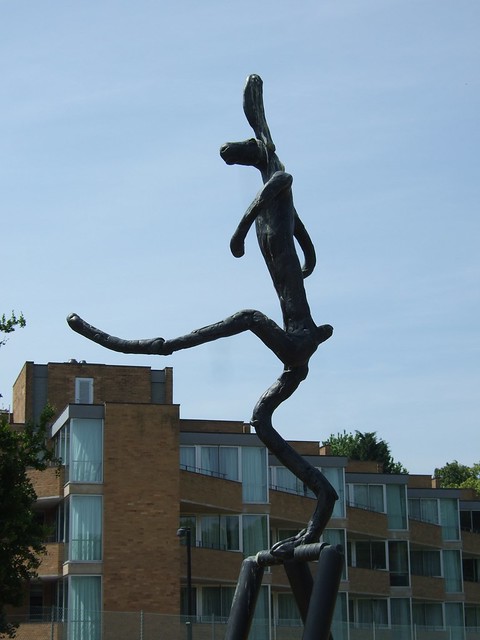
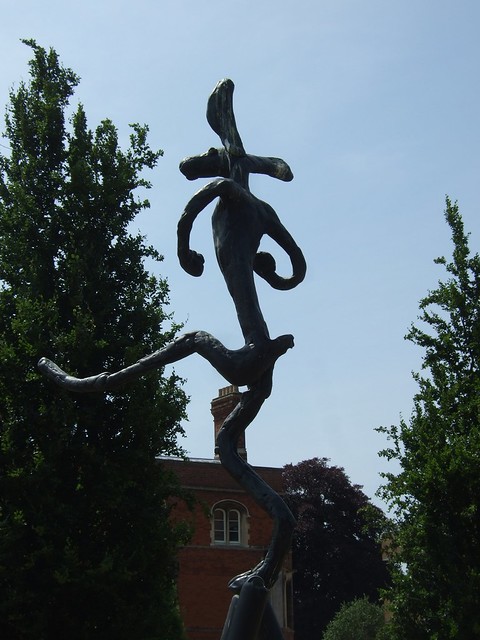
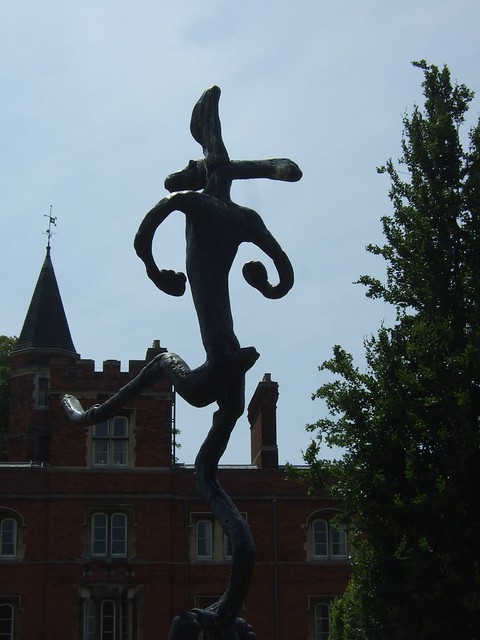
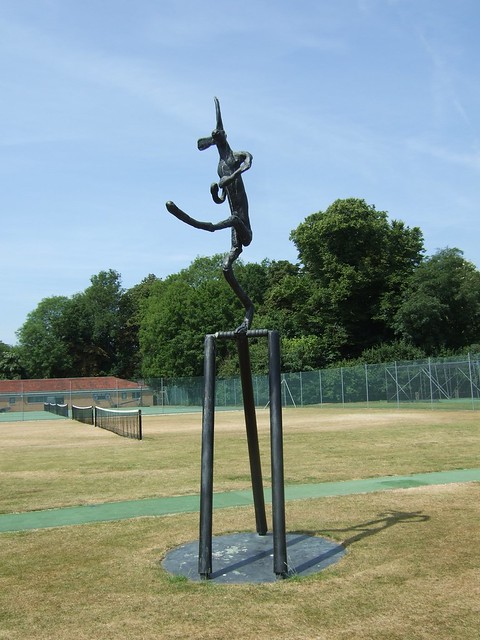
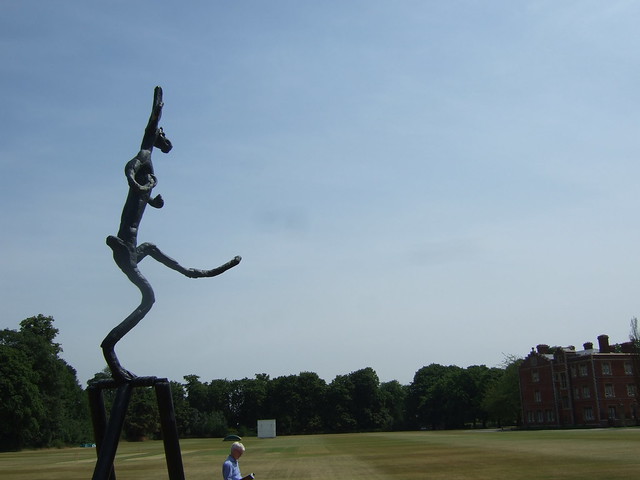
Barry Flanagan's Cricketer (1989), Jesus College, Cambridge

Sculpture is three-dimensional.  So we need to look at it from three dimensions.

Walk around the sculpture.  Note how it changes.

07 Flanagan, The cricketer


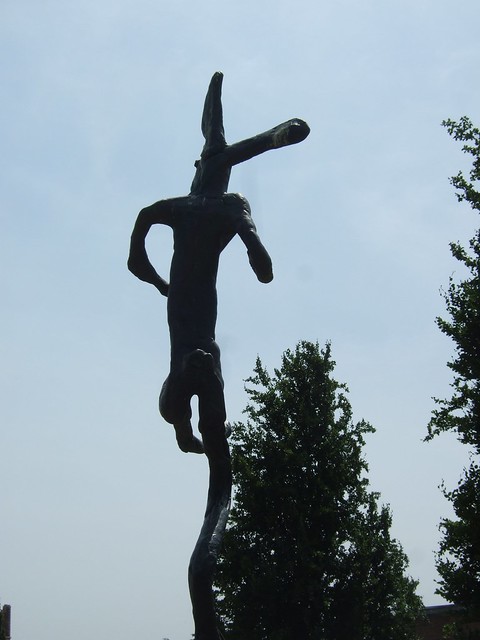
Barry Flanagan's sculpture is quite dynamic.  It keeps changing as you walk around it.  Which is the main view?  I would pick the one above as it shows all four limbs, the snout and ears, and the full extent of the kicking leg.


03 Flanagan, The cricketer


03a Flanagan, The cricketer

04 Flanagan, The cricketer

This view shows you the curled pose of the arms.


05 Flanagan, The cricketer

And this one makes it look as if the hare is running, with ears flapping behind.

How does the sculpture relate to you?

Of all categories of art, sculptures are the closest to humans.  They stand upright, just as we humans do.  (And when they don't, it's quite dramatic.)

 We look at them, as if they were people or anthropomorphic beings.

Flanagan's hare rises above us on a three-legged support.  He balances one long foot on the horizontal pole.  The whole pose is about balance.

Because we have to gaze up at him from below, we don't look him in the eye.


01 Flanagan, The cricketer


Western sculptures often have supports.  They stand on plinths.  This goes back to ancient Greek sculpture.

A traditional plinth:


remembrance2
Robert Tait Mackenzie's war memorial, Hills Road (read about it in my blog post here)

A plinth lifts the sculpture from the realm of the everyday and real into the special realm of 'Art'.  It also elevates the sculpture way above our heads.


A radically plinth-less sculpture:

Antony Gormley, Earthbound Plant, Downing Site, Cambridge (read about it in my blog here)


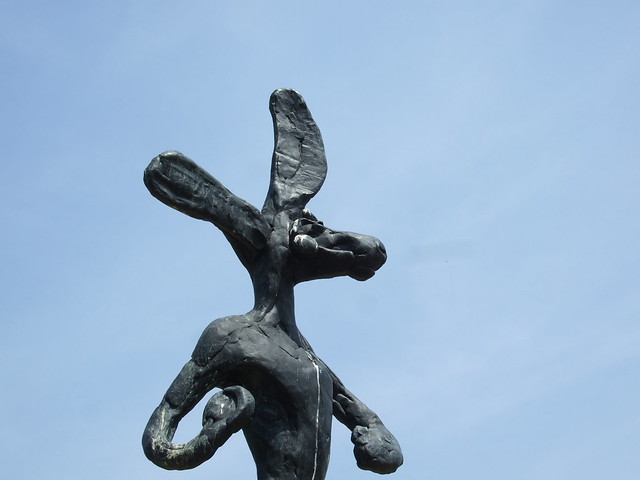
We can't look Flanagan's hare in the eye but the camera can zoom up close and create a detail.

Notice the texture and reflections of the material.  Material is very important for sculpture.  The Cricketer is cast in bronze.  We see the joints of the plaster of the sculpture (before it was cast).  We see the lumps and uneven bits; we can almost imagine the sculptor's hands moulding and forming the material.

Bronze also reflects the light.  Flanagan has chosen not to polish this bronze to a high gleam so it's a bit matt.

If he weren't so high up, I'd knock the hare on his legs to see if he's hollow.


08 Flanagan, The cricketer detail


Here are some different materials:

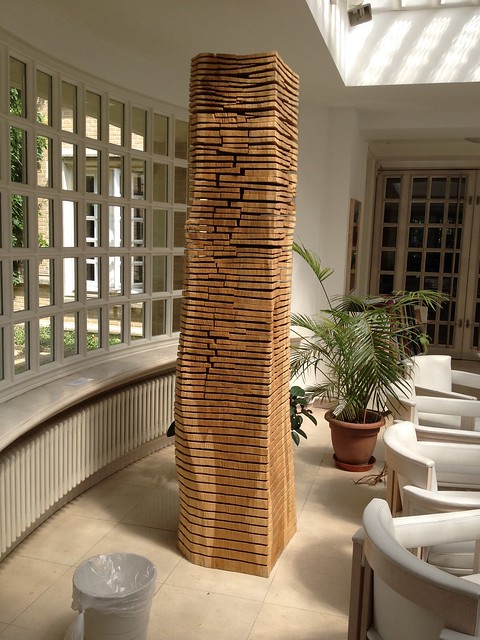
Wood.  This reflects very little if not polished.  You can see the grain.  You can feel the rough surface texture.


Nash, David, Crack and Warp Column, Jesus Library
David Nash, Crack and Warp Column, oak, Jesus College Library, installed 2007 (not accessible to the public but see it through the window)

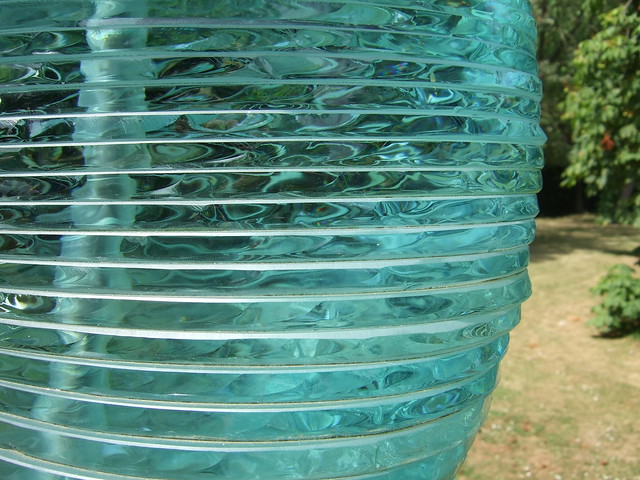
Glass.  This reflects light a lot. And the sky.  And the leaves.  It also reflects you when you peer at it.

Feel it:  cool and smooth.


Lane, Danny, Empress detail
Danny Lane, Empress (detail), layered glass, Jesus College grounds

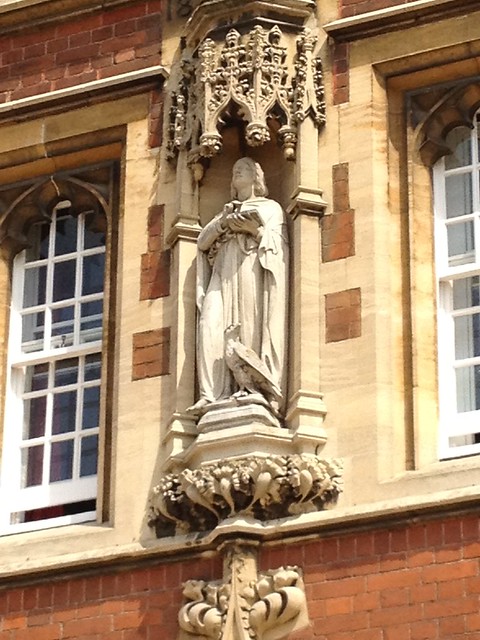
Stone.  Stone can reflect light, if it's polished, and some stone, like marble, also has its own internal luminescence.  This statue is probably of Saint Radegund, patron saint of the mediaeval nunnery which forms the core of Jesus College.  This statue's stone is quite matt.

Look how the drapery creates a play of light and shadow that animates the figure. Sculpture always reckons with shadows.


Jesus St Radegund
Stone statue in a niche attached to a façade in Jesus College

Flanagan's Cricketer casts a distinctive silhouette shadow on the grass.

01 Flanagan, The cricketer

The lumps and lines on the bronze also create their own internal attached shadow play.  This changes, depending on the time of day and the weather.  (That's why it's great to look at outdoor sculpture.)

Take another look at the hare's right hand:  it's curled around a ball.  This must be a cricket ball.  After all, this sculpture is called Cricketer and it stands in the cricket grounds of Jesus College.

08 Flanagan, The cricketer detail

Is this a hare or some other beast?  I think it's a hare because hares were a preoccupation of Barry Flanagan's.

Barry Flanagan, Leaping Hare on Crescent and Bell, 1988, Broadgate, London (near Liverpool Street station)
Source:  Wikimedia; © Jim Linwood.

06 Flanagan, The cricketer


All my examples are taken from the sculpture collection of Jesus College.

What:  The Cricketer, 1989
Who:  By Welsh sculptor Barry Flanagan who sadly died in 2009.
Where:  Jesus College cricket ground, Jesus Lane

Thanks to all my Korean students from the Kaewon School of Art & Design who came to Cambridge for a Summer School of language and art history, and joined me on a visit to Jesus College.  And a special thanks to Mike O'Brien who kindly showed me round and told me the fascinating history of the college.

Permalink:  http://artincambridge.blogspot.com/2014/02/how-to-look-at-sculpture-in-jesus.html

Tuesday, 26 February 2013

How to look at a boring painting -- and why

I was quite touched by everyone's positive response to my post about how to visit a gallery with children.  Thanks for all your feedback and extra ideas!  And I was quite surprised how many of you liked my suggestion to go to an art gallery and look at a boring painting.  

So I thought I'd follow that up.  ;-)

Why be bored?

We aren't used to being bored.  We're used to being entertained and distracted. If something's not 'fun' or 'spectacular' or at the least, 'interesting', we've been trained to reject it. This goes for everything, from school to movies, books and art exhibitions.


The idea is: if you're not grabbed immediately, you might as well give up.

The merits of being bored

If you're bored, your brain is forced to be active. Everyone knows how inventive bored children can be and how they can literally make toys out of toilet rolls. And have you never had a brain wave in a less-than-mesmerising work meeting? *g*

You're going outside your comfort zone. What is one person's boring painting is another person's beloved masterpiece so being bored is not about the work of art: it's all about you. And that's what makes being bored interesting.


So here's what to do:

Go into a gallery. Pick a painting (or sculpture or print) that totally bores you. Plant yourself in front of it and just stand there for 10 minutes.

Take out your notepad and take notes. Write down everything you see.  Make a sketch (who cares if it's rubbish?).  This helps you to deal with the boredom!  But more importantly: once you've covered two pages with observations and scribbles, you'll probably start to be weirdly less bored. You may start seeing things that you hadn't realised were there!

Or perhaps you will discover why you'd been so bored in the first place. People's critical faculties tend to be much sharper when faced with art that they don't like. In front of something we love we dissolve into an adoring mush.  We gush: "It's fabulous, it's awesome, what genius!"  But if we don't see the point of something?  We will really look at it with critical eyes!

We will also not gush vaguely ("awesome!") but be very specific: "This is horrible. Look at those vile colours in the background, and that spiky thing on the left: I don't even know what that is! And I like to know what things are in a picture! And the arm on that woman is much too short; the perspective is all wrong."

So that's when it gets interesting. Why do we not like spiky things? Why do we need an arm to be a particular length, and what is the 'right' length? Why does a picture need to have 'correct' perspective?


Be more interesting than the art you see

If a picture is boring, your thoughts have a chance to be more interesting. Make your thinking more interesting than the boring work of art.

Last week, I used myself as a guinea pig. I went to a room in the Fitzwilliam Museum which is full of pictures that bore me brainless, and I stood in front of two of them for 10 minutes.  I will post about this in my next post!

So come back soon and find out what pictures I find truly dull. :-)  Until then: have a lovely mid-week.


Don't miss out on the boring sequel to my quest:  Subscribe to my blog per email!

The next part in the 'boring' series will be posted on Tues, 5 March!  Title:  Why I Hate Gallery 17.

Follow by Email

Wednesday, 13 February 2013

Nine fun things to do with children in an art museum or gallery


On Saturday, I was in London where I saw a family posing in front of Tate Modern for a photo.  "I hate museums!" yelled one of the children.  "Museums are boring!" yelled another.

Have you ever tried to drag reluctant kids into an art gallery?  Here are some fun ideas, most of which I've tried myself when the children were young.  (Now they go to galleries voluntarily so something must have worked...  *g*)

The following ideas will work in most places.  So whether you live in Cambridge or in another town, try  one and let me know!


Nine things to do with children in an art gallery or art museum

1. Alarm the kids
Galleries can be difficult.  While some are child-friendly, others don't allow push chairs or strollers, and many have nervous security guards.  Few allow running or touching of the art. 

Turn this into an asset.  Explain how a gallery is full of precious treasures and how these are guarded by guards and wired up to an alarm system.  If visitors come too close, the alarm will go off.  

Tip:  This works well with very young children who find the idea of the 'alarm' quite exciting.  


2. Always take paper and pencils 
Best to bring a pad of paper and some pencils.  Avoid felt pens and crayons; these can get too messy in a gallery.  Go to one room.  Ask the children to choose their favourite art in the room and draw a picture inspired by it.

Tip:  Don't worry about 'copying' the picture.  Encourage everyone to draw what they like.  Join in.  Then talk about the picture and what it was like to draw it.

Source:  Stock.XCHNG

3. Scavenger hunt:  Spot the detail
Prepare this one in advance.  Give the children a sheet of paper with details from 10-15 paintings in the gallery.  Ask them to go and find the paintings.

Tip:  If your local gallery has at least some of their collection on-line, this is easy.  You print out the images, cut them up and paste them onto paper.  If not, you can be more inventive:  for example, buy some postcards in advance and cut them up.  

Variation for a group of kids:  Distribute pads and pencils.  Send each child alone (or in pairs) to a different section or room of the museum and get them to draw details from paintings of their choice.  Then they exchange pads and try to find the paintings whose details they see.

 
Details from Rebecca O'Hanlon's photo; Helene Fesenmaier, A Bit of Cheese, a Devilled Egg and a Picnic (seen at Trinity Hall, Dec.2012); David Poole, Rodney Thomas, Architect and Artist, in the People's Portraits collection, Girton College


4. Treasure hunt
This is a variation of the detail scavenger hunt but without the preparation bit.  Go to the gallery. Ask the kids to find a picture with:

an animal, an insect, a flower, a dead flower, a man with a beard, a cloud, a bare foot, a candle, a book, the colour blue, a picture that's not rectangular, a dragon, a princess, a baby, a square, something made of wood, a naked person.

(Most galleries will have at least one of the above.)


5. Outdoor sculptures
These are fabulous because in most cases you are allowed to touch outdoor sculptures,  often climb on them, and certainly photograph each other with them.


6. The 'Boring Challenge'
The kids are bored?  Go with that.  Pick a really boring work of art.  Force yourselves to stand in front of it and find one interesting thing about it.


7. Ask questions 
I would avoid telling children facts about a work of art or a style or a movement.  Instead, ask questions and respond to their questions by speculating.  What's your favourite in this room? How many colours can you see? Can you spot anything really weird about this painting?

The great thing is you don't have to feel pressured to know anything about art when you're with children.  Just share your thoughts. 


8. Go to the shop
Everyone gets to buy a postcard of their choice. What can you do with the postcard when you get home?  Send it to someone (surface mail! a radical idea...)  Pin it on the wall.  Draw on it. Cut it up into a jigsaw puzzle.  Make an advent calendar out of it.  Buy several and make a collage.

Tip:  The Fitzwilliam Museum sells ready-made mini-jigsaw postcards of the Chinese vases that were smashed into smithereens a few years ago.  Clever.  And an inspiration for the junior jigsaw-maker.


9.  Make time for the café
Most museums have a café.  Often these cafés are overpriced but they're well worth it for the atmosphere and for the chance to debrief and talk about what everyone liked or hated.

By the way, I've always found it best not to plan a whole day, or even half a day.  Speed is of the essence.  See 4 paintings in depth rather than 50 paintings.  This is why free galleries are so great: no pressure to 'get your money's worth'.  


This post is for all the wonderful women who have (alongside me) been taking part in Melissa's online blogging course (Content Brew Course) over the past week and many of whom have young children.  You've been an inspiration!


In Cambridge, your children may like:

Dinosaur sculptures (updated 2014:  These are no longer here, alas!)

Read more:
'Mother of all Trips' has some great ideas here:  How to take kids to an art museum.
Sandra's great day out with art and her grandson in Los Angeles (fabulous pictures: I especially like the amazing Metropolis II sculpture). 


Related Posts Plugin for WordPress, Blogger...